Showing posts with label Camargue. Show all posts

Monday, October 17, 2011

Other birds in the Camargue

There really were other birds in the Camargue, as well an odd animal or two.  Storks, eagles, swans, egrets, ducks and herons were all around, they just don't flock like the Flamingos.  On some of the outlying islands in the middle of the salt marsh, the storks had built their nests.  In cities they build on chimney tops, here they have built stands for them, or they use some of the few trees that grow. 

"I can see really well up here!"

They seemed to all get along.

Stork standing in a tree.  They looked to big or the tree to small to hold their weight, but it did.

The tallest bird is a heron, with a stork in the background and other birds hanging around..  This was an area where they fed the birds.

Two kinds of ducks.

Swans, always elegant.

Grey Heron known for their fishing skills.

This eagle had a damaged wind, so was unable to fly.
Since there is so much water, there are water loving animals; rats, voles, nutrias.  They are not concerned about the people walking around.  Makes them much easier to photograph.
This little guy was too busy eating to pay any attention to us.
The parc has a path to follow through the salt marshes, with bird blinds and a raised platforms for viewing.  The entire walk is over 10K, we took a shorter version of just over 6K, as the bugs were starting to bother Bill, even with repellent.  It was still a long enough visit. 

Sunday, October 16, 2011

The Wild Flamingos of the Camargue

Flamingos marching.
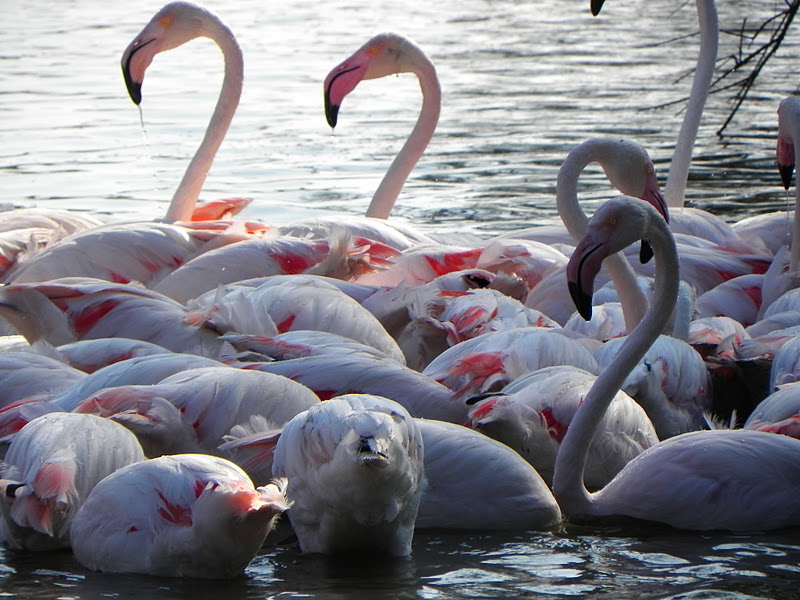
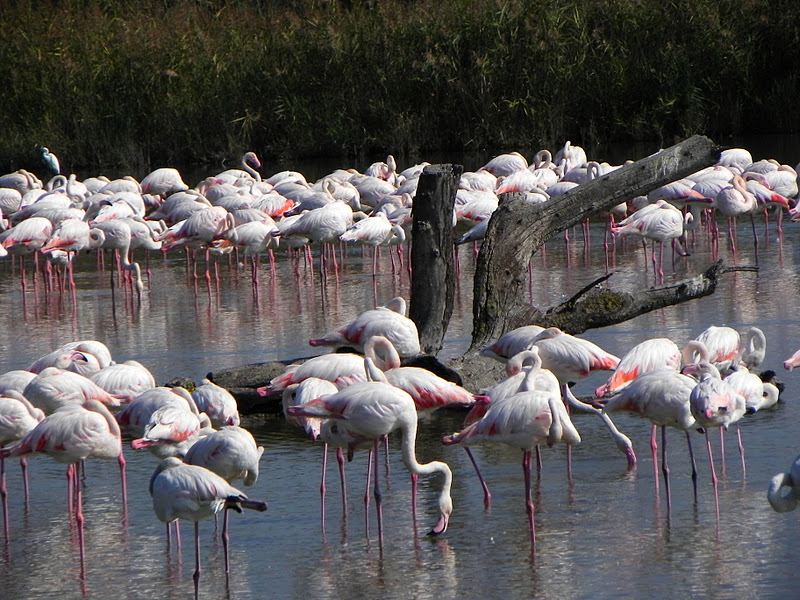
 The second largest group of Flamingos in the world live in the Camargue.  The largest is in Africa.  To see Flamingos in the wild is breathtaking.  I've only seen them in zoos before this, and they were pretty amazing there, but to see thousands of them quietly eating or is it slurping, thrilling.  We went to the Parc Ornithologic de Pont du Grau.  It is a sanctuary for all birds who live in the Camargue, some of whom have been injured so are protected in enclosures.  The majority just live in the area.  .
When one wants to get ahead, simply flap your wings until you are on top of the water and then walk to the place you wish to be.  Flamingos are amazing!

Walking on water.
 When we first arrived at the parc, there were several other birds on an island across from where we stopped.  Bill took pictures, we figured out what they were, when there was an odd noise off the right.  Swishing of water combined with an odd gutteral sound.  When we turned to look, there was a flock of Flamingos marching toward us!  One was in the lead, the rest followed; like you would see a flock of geese flying, only these birds were literally marching!
Flamingos dip there beaks down into the muck, then filter out the little critters they eat.
I don't know if flamingos are protected from hunting, if not they are a very large bird that would provide a good deal of meat. However, they eat muck, so they might not be very flavorful. The only time we tried mud hens, a duck, they were inedible.  Bill read in a book this evening that their only predator was zoo keepers.  We laughed.
Their beaks look like they have painted on lipstick.

Standing on one foot, with the other tucked up under.
 They eat by putting their bill into the muck and filtering out the algae they eat.  When they come up for air, their heads are covered in the muck.  Disgusting!  But, the muck seems to fall away from them.  None of the birds was dirty looking.
If we get a bit closer together, we can make a heart!

A Flamingo buffet line.  Yumm, blue/green algae. 
When we bought our tickets, I asked the man at the counter if there really were Flamingos.  He replied, with a smile,  "Oh yes, they will be here today, just for you!"  

Augues Mortes

The walls of the fort can still keep out invaders; as long as they don't fly.
Augues Mortes is the fortified seaport built for the Crusaders by Louis IX, who became St Louis, in the 13th century.  Since that time, the port has silted up and no longer connected to the sea, but is surrounded by salt flats. Off in the distance are salt producing areas with large piles of the white stuff glistening in the sun. 


Entering the square.
When we arrived, the place felt empty.  We knew it couldn't be, from all the cars in the parking area.  We walked down one deserted street after another, all the shops closed, until we came upon the square.  It is easy to forget that in the smaller towns in France, everyone closes for lunch, except the places which serve food.  The square in Agues Mortes was a bee hive of activity.

One of the street was alive as well, since every shop on it seemed to sell food. We picked a small place with shady seating which offered a sandwich/panini, a cold drink, and dessert for 6.50 euro.  It was very good to sit and eat a bite.  The day was hot and sunny, such a nice change from so much of this summer.
This young man was at the end of a group of school children.  When he turned for Bill to take his picture, his teacher, off to the left, came over and turned him back around, marching him off.

Do you think it might be lunch time?  While some of these folks were tourists, the majority were locals enjoying their lunch hours.

Piles of salt in the distance.
Augues Mortes is now one of the main salt producing areas in the world.  It is a little strange to see huge piles of salt sitting in the sun.  They look very similar to piles of dirt at a quarry, except for the color.  Several of the places we have sat this summer have had multiple flavors of salt in their kitchens.  The taste does change dramatically depending on where it was dried.  In some cases, they have added flavors.  The color varies widely, also.
Three of the famous Camargue Horses.

Blackness Castle and Linlithgow Palace

Two castle built during the same period, but for completely different uses.  Blackness Castle was a military fort on the Forth of Firth, whi...