Showing posts with label National Trust. Show all posts

Monday, July 13, 2015

The Royal Oak Foundation

We discovered the Royal Oak Foundation in 2010.  It is the American branch of the National Trust for England, Wales and Northern Ireland.  If you are a member, you get to visit all the properties of the National Trust, as well as those of the National Trust for Scotland.  You will even have a parking pass, which also saves money.

Membership for a couple is $95 per year.  All it takes is 3 visits to properties in the UK and your membership is paid for, any other visits are "free".  We are on property number 5, with many more to come during our stay in Scotland.

If you are planning a visit to the United Kingdom, we highly recommend membership.

Both sides of the membership card.  

Thursday, February 20, 2014

Buckland Abbey


A panorama of Buckland Abbey

A visit to Buckland Abbey was high on our list of  "Places to See in Devon", since Bill admires the exploits of Sir Francis Drake.  It was originally built in 1273, as a Cistercian Abbey by Amicia, the Dowager Countess of Devon after the death of her husband and the murder of her only son.  Her daughter Isabella, the new countess, provided the land.  Amicia is probably buried near the high altar.  There is a carved head of a lady above one of the abbey doors, that is traditionally said to represent her.

Map board showing the layout of the Abbey, gardens and great Barn.


In 1539, Henry VIII dissolved all the monasteries and the abbey and its lands were sold to the Grenvilles, who over the course of 50 years, turned it into a family home.  Many of the monastic buildings were demolished in the process.
The front entrance to Buckland Abbey.

Sir Francis Drake moved to Buckland in 1582.  He was already a wealthy man at age 39, as well as a favorite of Queen Elizabeth.  On his death in 1596, having no children, Buckland passed to his brother Thomas.  It remained in the Drake family, passing to a nephew who modernized it in 1794.  The last Drake descendent to live here was Captian Richard Meyrick, a distant relative, who sold it to a local land owner, after a fire badly damaged the abbey in 1938.

Walking up to the Abbey, every thing was lush green.

The last owner was Captian Rodd, who donated the abbey and great barn to The National Trust.  Working with the City of Plymouth, they turned it into The Drake, Naval and West Country Folk Museum we visited today.
Inside of the great Barn, originally built by the Cistertian order.

Sunday, September 01, 2013

Avebury Manor, Gardens and Museum

Avebury Manor

Driving back from Uffington and the White Horse, we decided to go by Avebury.  Places here are remarkably close, even if they take a while to drive to.  We had visited Avebury before to walk among the stones, one of the largest circles and avenues in England.  The stones are older than Stonehenge.  The Manor and museum weren't opened for visitors; both being renovated.

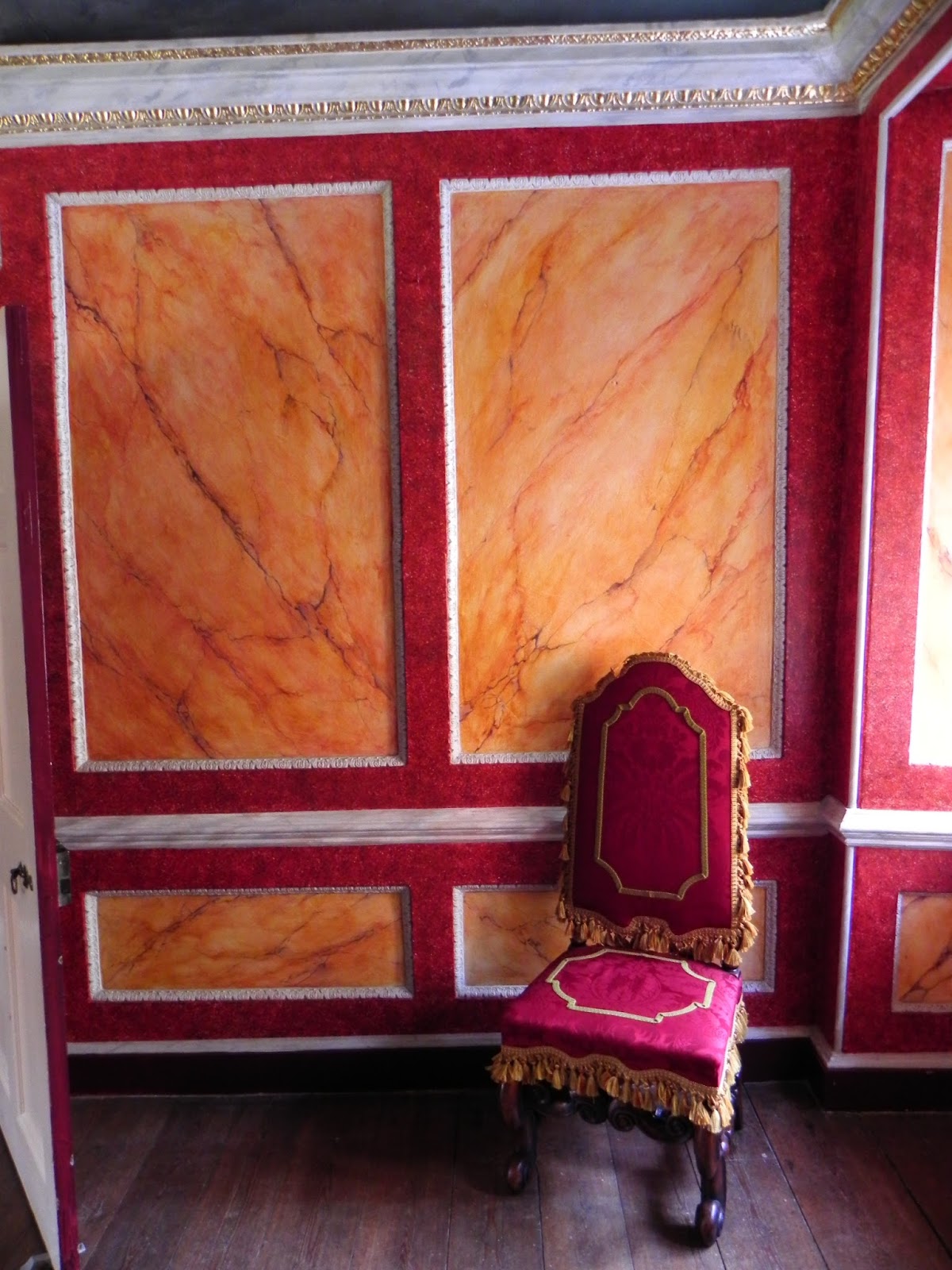
The Queen Anne Suite from 1712.

Hand painted Japanese wallpaper in the dining room, the one thing you can not touch!

The dining room is set for 1798.  There is an exercise chair which you bounce up and down just in case you feel you have eaten too much.

The Tudor Parlour from the 1550's.

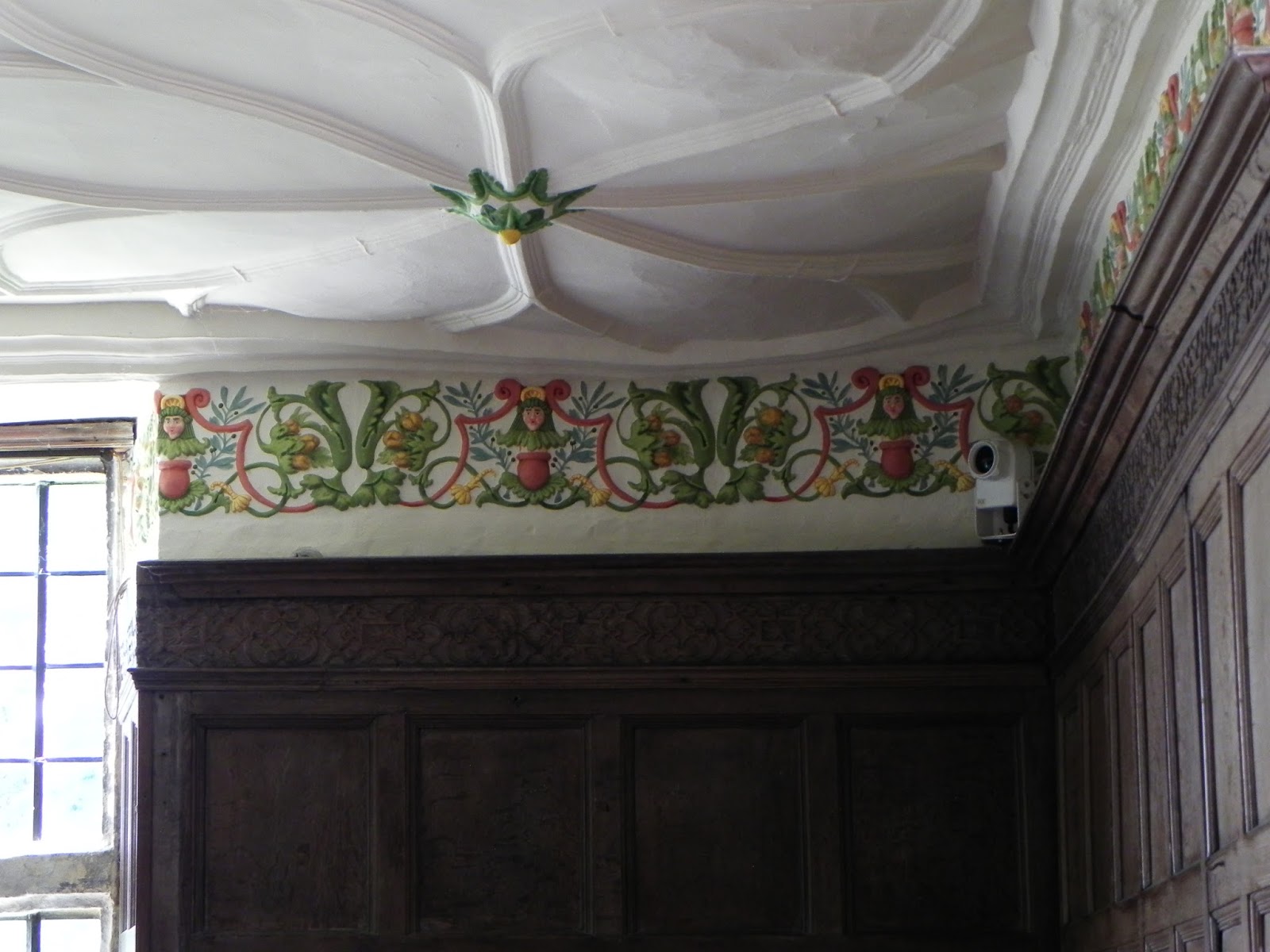
The ceiling in the Tudor Bedchamber.

The Manor was where Alexander Keiller lived in the 1930's while leading the excavation of the stone circles.  It was built in the 1550's and has been owned by several different families.  The house and gardens were renovated by the BBC working with the National Trust over a 6 month period in 2010-2011.  The BBC made a documentary and published a book about this endeavour.  There are seven rooms, each transformed into a time period when the house was owned by different families, ranging from Tudor to 1939.


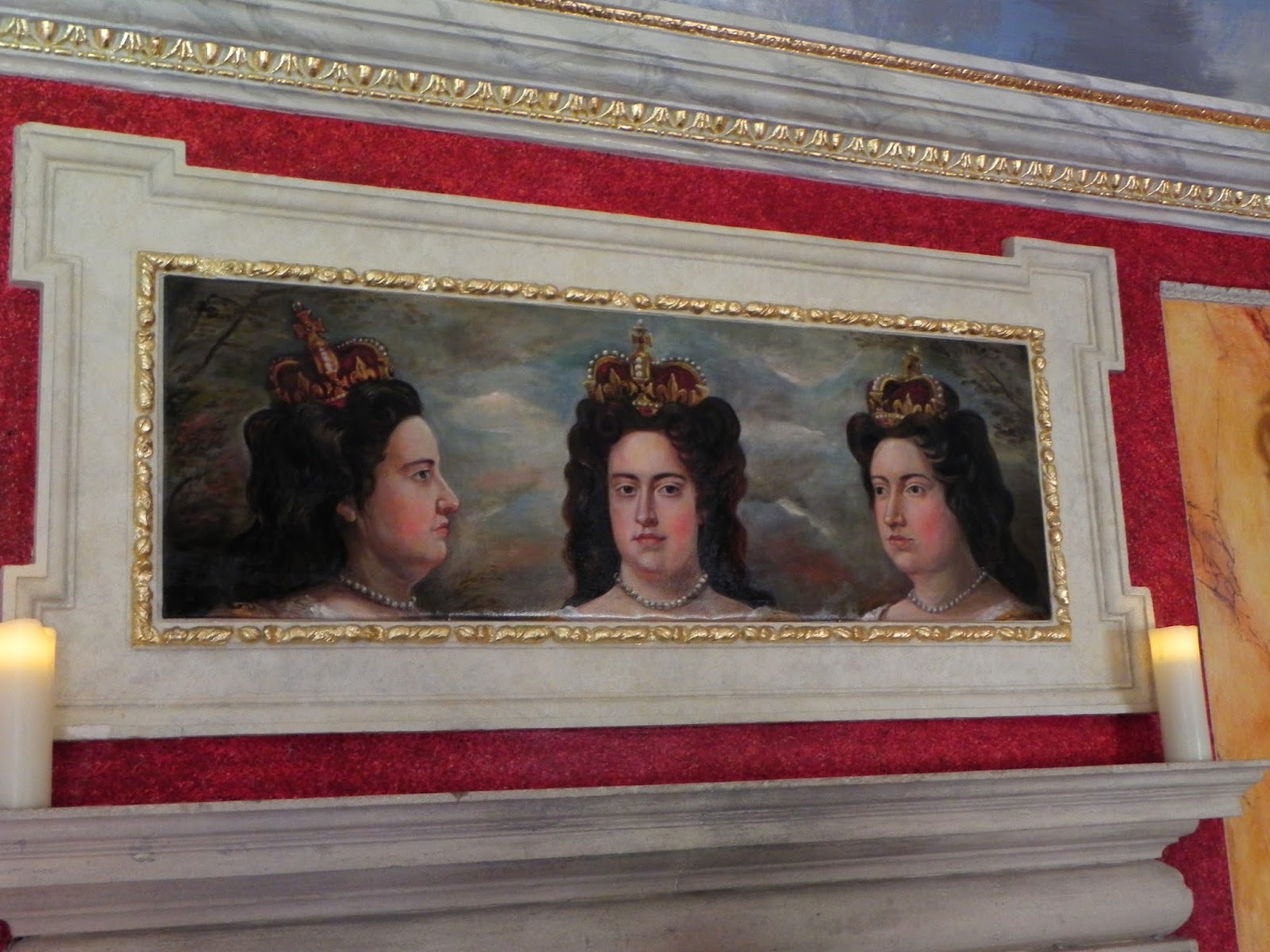
Portrait of Queen Anne who is said to have visited.

Unlike all the other places owned by the National Trust, this one is hands on!  Sit on the chairs, open the drawers, find the secret passages, take a nap on the beds; please, though, don't touch the hand painted Japanese wall paper in the dining room and remove your shoes before getting on the beds.  There is also period clothing in various rooms that you may put on.  This is one fun place for kids and adults!

Game of billiards anyone?

The kitchen on a busy day in 1912.  The sink was full of dirty dishes.

Keiller Parlour from 1939;  I felt as if Hercule Poirot should walk in at any moment.

The walled garden was transformed into a Victorian Style kitchen garden during this same renovation by the BBC.  The formal gardens are still as they were; beautifully trimmed hedges and lawn, with the entry garden now planted with a riot of colorful dahlias.
Nothing says English like trimmed hedges in the garden. 
The kitchen garden complete with glass house.


Dahlias!

The museum is in two places, one a small building next to the Manor.  This contains items found during Keiller's work with the stones.  The second is in the old barn, now renovated with a new thatched roof.  This has more of an over view of the area from it first inhabitants to now.  Both are very well done.
The barn, now the museum.

The construction inside is amazing.

We took a short stroll through part of the circle on our way to the carpark.  Then is was back on the road for our drive home to Alderholt.  Trevor and Friday were waiting for their tea!
The stone in the circle.

One of the largest stones with sheep grazing.  They are more efficient  than a riding mower.

Saturday, August 31, 2013

White Horse Hill

The head, eye and ears of the White Horse.
There are white horses carved in the chalk of the mountain sides in Oxfordshire.  They are as recent as the 1800's to as ancient as the Bronze Age.  We had to find the one that's the oldest, of course, near the village of Uffington.  Getting there didn't seem like a problem.  The roads were all major highways, although not the M roads.  What we should have known after driving here was, if BiB says it will take 1 hour and 15 minutes, you will be lucky to get there in 2 hours.  The "highway" was two lane, sometime narrow, that had everything traveling on it from cars to semi's.  The average posted speed was 60 mph, the actual speed was 30 mph.  Then we turned off onto the next size down road.  Posted speed 40 mph, actual speed, if you were very lucky, 25.
The two rear legs, part of the body and two front legs, kinda showing.
We did find the horse.  It is carved onto the side of the hill, very stylised, almost, modern art in it's design.  For the best view, one needs to be flying.  There was a parasailing club from Oxford who was doing just that.  Oh how we wished we could join in!  People have been working at keeping the horse chalked since the mid-1700, when the land owners would get their workers to spend a day, complete with picnic and a party, re-chalking the horse.  This is also when the newer horses were carved elsewhere in the county.

These rolling hills down to a plain were caused by glaciers.  If you look closely at them, they are ridged sideways across.  This island is still feeling the effects of the last ice age; there was an earthquake in the past week that was blamed on the change in weight from the ice melting.  Guess is just took the land a long time to realize it was gone.

Tuesday, August 20, 2013

Little Moreton Hall

Little Moreton Hall

From "Your little pocket guide to Little Moreton Hall", courtesy of the National Trust:
"The year is 1599, the 41st year of her gracious majesty Queen Elizabeth I's reign and if you had been alive at that time you would probably be relived to have survived the recent outbreak of the Black Death!
The courtyard where you can view all the ornate wood and carvings that make the house special.

This style of house has carvings on all the posts.

Richarde Dale was the name of both the father and son carpenters who built the house for the Moreton's.

Recent harvests had been poor, leading to starvation and disease, but William Moreton's estate was growing-the hiring fairs at Little Moreton Hall would be busy as more and more poor people sought work.
While an electrician was working on the walls, he uncovered this painting, which was in style from 1575 to 1600.  The Trust preserved it for us to see.

When this went out of style, the entire wall was covered with oak panelling.

England, however, was enjoying a time of peace and greater prosperity as trade grew, and in far off London people were enjoying the delights of the newly opened Globe Theatre, where William Shakespeare was showing his new work, Hamlet."

Upstairs, a platform bed was built into an alcove.

The family believed in education.  Too bad they didn't believe in engineering.
Little Moreton Hall was originally two stories, but as the family prospered, they wished to show off their wealth by adding another story, the long hall.  This space had glass on all sides, another sign of wealth.  Unfortunately, they didn't use their money to consult a good engineer.  This addition was only supported by the ceilings of the floors below instead of the walls.  So, the entire building leans as the lower walls are pushed out.


The docent in the long gallery, which is the name of the addition, put a small level on the fireplace.  The fireplace is level, the walls are not!

They added metal rods to pull to walls together.  Notice the beautiful designs on the ceiling.
In the 1700's, the owners added bars to pull the walls together.  Then after the National Trust took ownership, an additions 3/4 of a million pounds were spent to add steel beams to keep the building from collapsing!
The side of the house showing the intricate brickwork on the chimneys.

The gardens with small boxwood hedges.

One of the inhabitants of the moat.

Wednesday, August 14, 2013

Quarry Bank Mill


Samuel Greg came from Belfast to build his mill.

Quarry Bank Mill in Styal.
The Northwest of England is known as the birthplace of the Industrial Revolution.  There were many different mills, harnessing the readily available water power from the many rivers.  Quarry Bank Mill, now a National Trust property, was built by Samuel Gregs in 1784 to make glass cloth from cotton.  They first used pauper children, who were housed in the Apprentice House during their indentureship, which lasted until they were either 18 or 21.  Children as young as 9 lived and worked here, 13 hour days, 6 days a week.  On Sundays, they went to church and attended school, as all were taught to read and write. According to historical reports, some written by the children themselves, the Gregs treated them well, for the times.  In hindsight, it resembles slavery, but with a time limit.


More modern machinery than the children worked on.

The weaving machines in action.  The cloth is sold in the gift shop.

Making the cotton into thread, 500 spools at a time.

After laws were enacted in the 1830's, using children became less profitable, so Styal village was built to house hired mill workers and their families.  These were better living conditions than in the cities, as each family had their own latrine, instead of sharing with 100 others.

The inside of the most powerful water wheel in Europe. This is not the original wheel used at the mill, but one brought in from another mill.  The diameter of the wheel is 24 ft with a width of 22 ft. 


The machinery that keeps the wheel turning.

The machinery still is in working condition, used to make cloth which is sold in the gift shop.  The docents were very willing to turn them on so we could watch.  Some of them, such as the one which turned large spools of cotton into fine thread, were fascinating to watch.

The river Styal which provides the energy to move the wheel.  Keeping up with the times, the National Trust is building a power station on the river as well as a fish ladder.

There is a garden, built in an old Quarry Bank, hence the name, that had elegant planting, while the garden at the top of the bank was used to grow most of the produce needed for the Greg family.  The stone from the quarry is a red limestone.

The red limestone in the Quarry Bank. 
There is a new production on the BBC, The Mill, which was filmed at Quarry Bank Mill.  It is the story the mill during the time children were used.  There has been a bit of creative license, but having seen part of it, I would recommend it if it comes to PBS.

Tuesday, August 13, 2013

Lyme Park


Lyme Park as seen from the gardens.
The front of the house with a circular drive.
 
A visit to Lyme Park was our first outing from Werneth Low.  We are members of the Royal Oak Society, the American branch of the National Trust.  As members, our parking and entry fees are waived.  We soon make back the cost of our membership.  When we drove up to the entry booth, the gentleman looked at our parking sticker, asked to see our membership cards, then had a reaction we have come to expect "Ah! You're Americans!  Welcome!"  He then gave us a map of the grounds and a cd to play on the drive up to get us in the mood.

The inner courtyard with a well in the middle.


The Dutch garden was meant to be viewed from above, so there are two different levels of walkways to give one several perspectives of the plantings.

The drive is long, gently winding, and elegant.  If you have seen the BBC version of Pride and Prejudice, you have seen this house, as it was used as Pemberley, Mr. Darcy's home.  Since this is the 200th anniversary of the publication of the book, the house is in full scale celebration of having the movie made here.
The Orangery was full of exotic plants that won't live in the cool English climate.


Voluteers keep the gardens growing beautifully under the direction of 2 master gardeners.

Inside, the house is decorated as in the Edwardian era, the time leading up to the Great War, WWI.  It was a time of elegance, manners, and people staying in their places.  Owners upstairs, servants down.  After the war, everything changed, then by the end of WWII, most of these stately homes could not longer be maintained by the owners, so were given to various trusts.  Unfortunately, no photos are allowed inside the house.

Fallow Deer seen from the gardens, which are well fenced to keep them out.   We hope to go back and hike in the open areas to get a look at the Red Deer herd.

The gardens are beautiful, most in excellent repair.  Lyme Park is home to the largest herd of Red Deer in England.  The Legh family, who lived here from 1388 to 1946, also bred the Lyme Hall mastiff, which is prominent in the current breed of dog, even though the strain is no longer true.  You can, however, buy dogs biscuits with one of their pictures on the label.

Buy your dog biscuits here!

Blackness Castle and Linlithgow Palace

Two castle built during the same period, but for completely different uses.  Blackness Castle was a military fort on the Forth of Firth, whi...