Sunday, June 27, 2010

A Day on the Coast


The weather was beautiful, so we decided to find some more places from the National Trust. The crooked roads took us first to Castlerock, a cute little village where part of the old seawall is made from stones cut from the Giant's Causeway, well before it was a protected place.


Journeying further along we came upon Downhill perched on the edge of the rugged headland, jutting out into the sea. The mansion was built in the 18th century by the eccentric Earl Bishop, one of several houses he owned. The construction is stone block, with large rooms to house he art collection. After a fire in the early 1800's, it was rebuilt with a garden room, complete with retractable roof!


The Earl Bishop also constructed a round building right at the cliffs edge which he named the Mussenden Temple, after his sister in law. The building has four opening, positioned for each direction. The front door is south, with windows on the other three; the one looking north over the ocean is breathtaking! The Temple was originally a library, but the walls are bare.
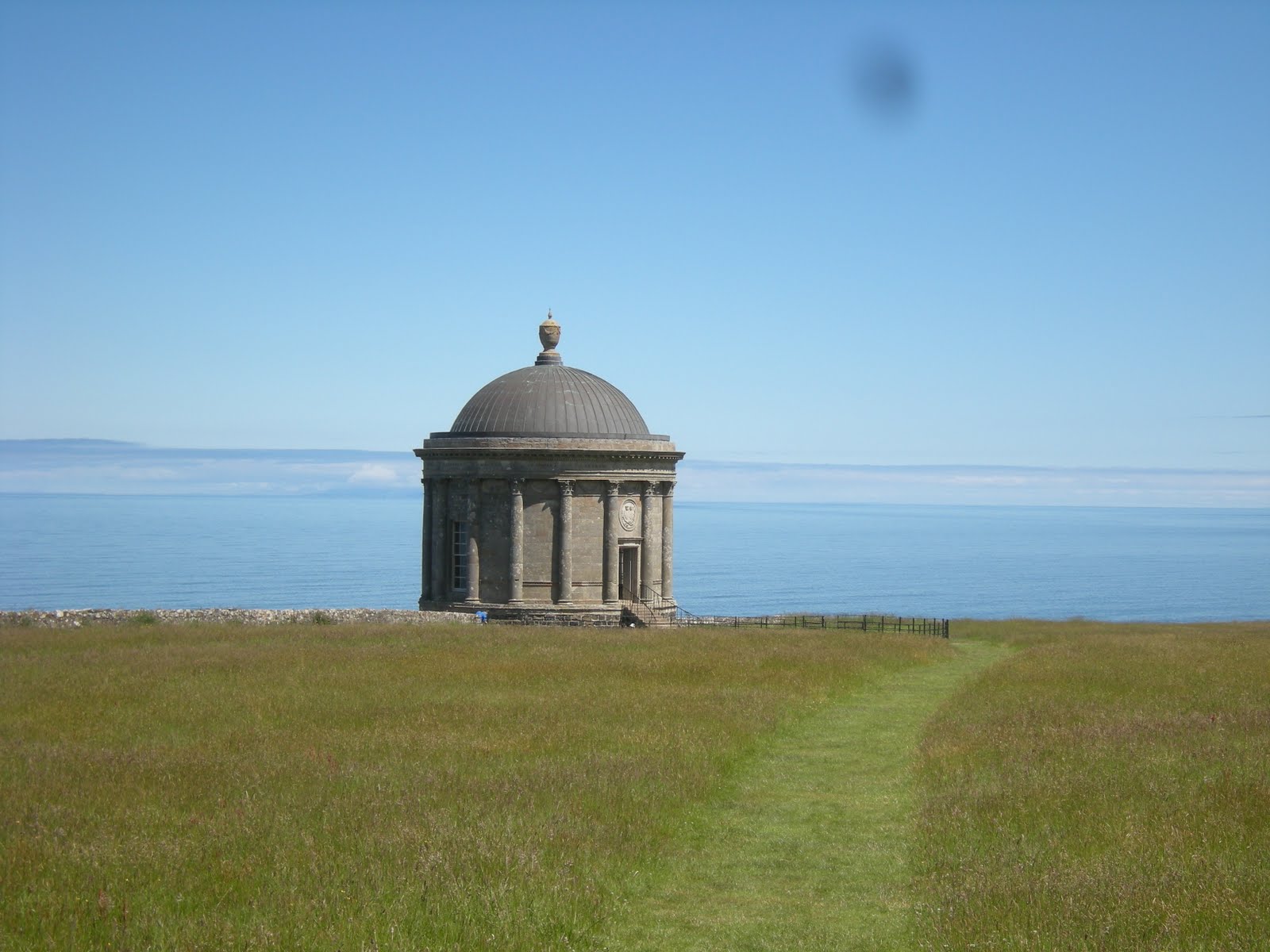


Now for the sad part of this story. The house was still inhabited in 1949. The RAF used it during WW2 for housing. After the war, the owner fell deeply into debt, so, he stripped the place, selling off the art, furnishings, any wooden parts, such as staircases and eventually, the lead roof, leaving the entire building opened to the elements! The National Trust was finally able to aquire it in 1970's.


We left Downhill rather depressed, and drove down the road to Hezlett House, a 17th century thatched cottage, the arrived to the National Trust intact. They even gave us packets of seeds to plant!


Time for the beach at Magilligan Strand! There were some brave souls playing in the water, but we were happy to spend our time looking for shells.
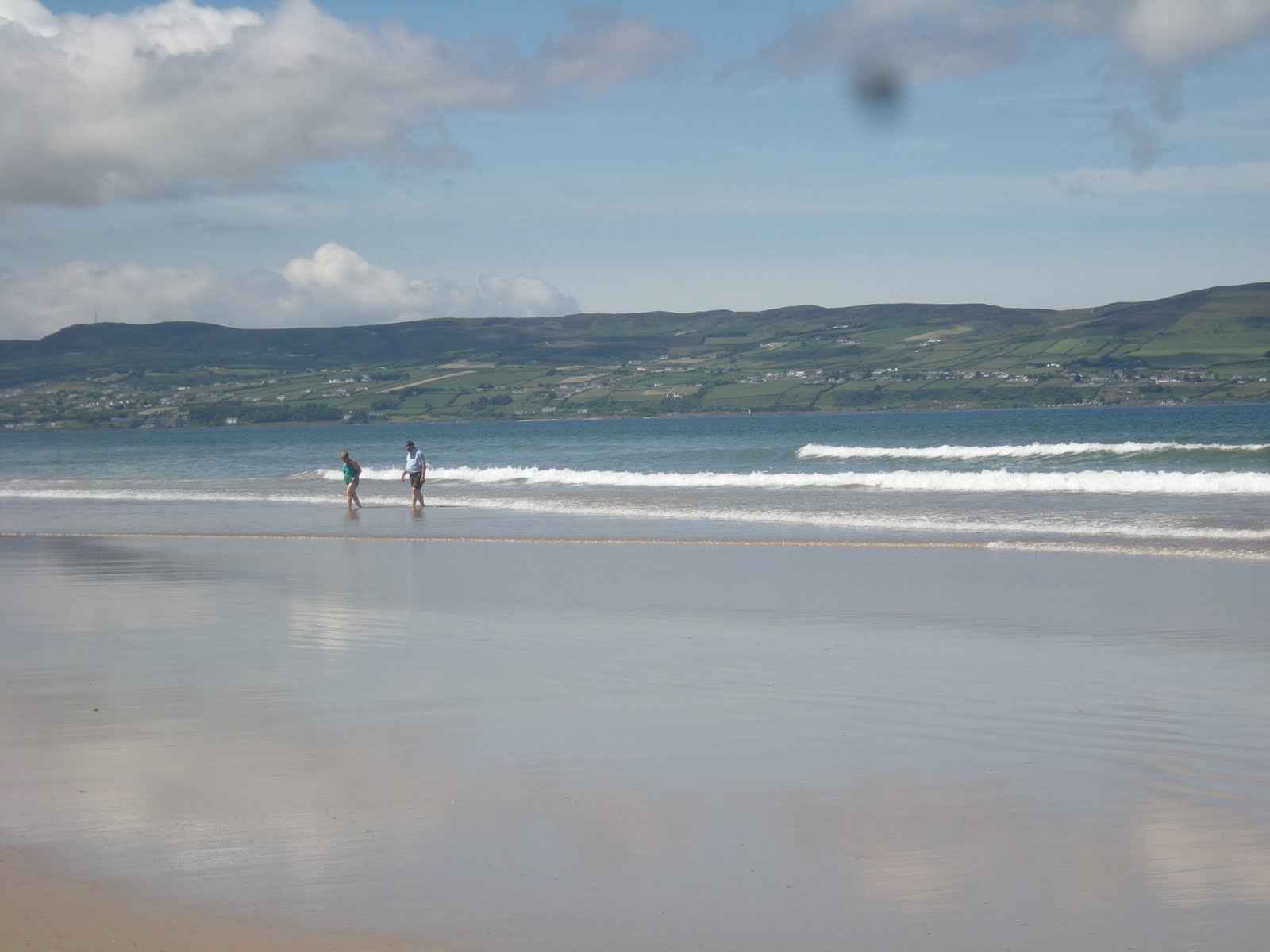


On the way home, we drove past Binevenagh, a 384 ft mountain. Honest, it looks bigger in person!

Saturday, June 26, 2010

Ulster American Folk Park, Emigration from the Irish Point of View

Few of us realize that without the Irish, especially the ones from Ulster, America would not be the great country it is today. After going through the Ulster American Folk Park, there can be little doubt.


The park is a collection of buildings, starting with The Old World. There is a single room cabin, Weaver's cottage and Meeting House with a Vestry; to give you a feel for how the locals lived in the 18th and 19th centuries. These are followed by the Campbell house, Tullyallen Mass house, and the Hughes House, the boyhood home of John Joseph Hughes, the first Roman Catholic Archbishop of New York. We even found a cart like John Wayne gave Maureen O'Hara in
"The Silent Man"!


Entering Ulster St, you find yourself visiting 19th century storefronts, complete with post office, Chemist, printer and Reilly's Spirit Grocers, a pub which also sold groceries. Then you enter the docksides with a ship showing the size and telling of the condition the emigrants withstood. Exiting the ship, you have 'landed' in America! Time for some culture shock!


The houses on the New World side are mainly from Pennsylvania. There is a log cabin, log barn, such as we saw regularly around Mertztown, a log farmhouse from the early 1800's and a western Pennsylvania log farmhouse from the 1900's.


Now why so much from Pennsylvania? The Park also contains the boyhood home of Judge Thomas Mellon, the founder of Mellon Bank in Pittsburgh, PA. His family, over the years, have been major donors to the Park, with the log house and earlier log farmhouse being replicas of the ones built by the Mellon family when they arrived in America.


We enjoyed our visit, as well as the information, although some of it was a little off. Such as the docent who explained that one of the houses was new to the park, coming from West Virginia over close to the border with Hawaii. We think she meant Ohio.

Thursday, June 24, 2010

Derry/Londonderry; The Slash City

What one calls this city on the Foyle River, depends on your political persuasion. For Nationalists, it's Derry, for Loyalists or Unionists, it's Londonderry. Because it is nearly always referred to with a slash between the two names, lots of the locals call it Slash. Gotta love that Irish sense of humor!


Derry has the oldest, most complete set of city walls left in Ireland. It has always been a fortified town. We were able to walk the entire way around the old town on the wall. The views were great.


One side of town is Loyalist and the other side is Nationalist, each with their appropriate signs and art work.


We found Derry to be very busy. Lots of cars and trucks. Impossible to find a park. Pedestrians, especially young mothers with strollers. Pensioners enjoying the nice weather, even though it did look like rain. Construction and reconstruction, everywhere. We skipped the St Columbe cathedral because with all the construction and renovation going on, we couldn't figure out how to get in!


After what seemed like hours of walking, we stopped into a local pub, The Gainsborough, for a pint. It was a good choice; no tourists, but us, and as we sat and sipped, more locals came in. A elderly gentleman, dressed in a suit with cuff linked cuffs on his shirt, sat down by me. He had the most beautiful cane, which he told me was Blackthorn. He asked where we were from, then referred to our place of residence as "The Americas", as he had family who had emigrated to Long Island, New York. Everyone in the pub started listening to our conversation. The gentleman had suffered a stroke, so had to speak slowly and think between his sentences, as well as to my replies. He was a war veteran, who still did his own shirts, but let others 'put a crease in my trousers'. A thoroughly delightful gentleman, who did say it was much nicer since the end of the Troubles. As we were leaving, he took my hand and said, 'In Ireland we do not say goodbye, we say Safe Home'.

Wednesday, June 23, 2010

Castles and Spades


Carrickfergis Castle is the best preserved remaining Norman castle in Ireland. It was built by John de Courcy around 1177 , starting out as a simple Keep but gradually expanding over the years until it was a proper Castle by 1250. In 1760 it was heroically defended against the French who greatly outnumbered the English soldiers, who used their tunic buttons as ammunition, and eventually, surrendered. In the early 19th century it was again rearmed to do battle with the French. This time they added 22 cannons!


The location for the castle is spectacular, being built on a rock point that sticks out into the bay of Carrickfergis.


This being the end of the school year, there were several bus loads of school children on field trips. The children here wear uniforms, complete with ties and jackets for both boys and girls. The girls had skirts with matching knee socks, while the boys wore trousers. The only non uniform item were their backpacks or bookbags, some plain, others quite fancy.


On the way to Carrickfergis, we passed a sign for Patterson's Spade Mill. Since it is a National Trust property, we decided to take a look. What a pleasant surprise.


This is the last surviving spade mill, not just in Ireland or even the UK, but in all of Europe! The tour took us through the entire production of a spade, but there are 170 different styles in Ireland alone!


Each type of spade has it's own handle style, with the length of the handle made to the correct height for the person who will be using it.


There are two spade makers working in the mill. They are looking for younger people to teach the trade secrets to, so the skill does not die.


The mill is run by a water turbine which was built in Connecticut.


Tuesday, June 22, 2010

The Circles at Beaghmore

Driving from Kilrea on our journey to find the Circles of Beaghmore, the roads were progressively narrower and narrower, until we drove out to the circles on one lane. At least it was paved! Finding the circles was quite easy, they had signs once we were within 2 miles.

These stones are the smallest we have seen set into circles. The tallest was about my height.

It was quite easy to visualize people moving these stones, unlike the huge ones in other places. Beaghmore is dated at 6000 bc, that makes them older than Stonehenge, but younger than the stone rows at Carnac in Brittany. Like a lot of things, circles seemed to get fancier as they went on.


Beaghmore is a series of 7 circles. 6 are set in pairs with a rock caern between them. In the caerns were found cremated remains; a burial place for one person. Leading to the single circle were two lines of rocks, one for lining up the summer solstice sunrise, the other to show the moonrise on the same day.


When these stone were erected, the land was forested. Over time, the forests died and the area became a bog. It was in the 1960's that peat cutters, a main source of heating fuel in Ireland, reached the level of the stones. Fortunately for us, they realized this was something unusual, and called in the University to figure it out.


Place such as Beaghmore always feel special to me. Why would people who had to work every minute just to survive, take the time and energy to build these circles? There are many theories. I think they did it because it was enjoyable. And it is still enjoyed by people, 8000 years later.

Monday, June 21, 2010

Springhill House and the Weelbrook Beetling Mill

Northern Ireland has been working to build it's tourist industry. While we have seen a few tour buses about, these have only been at the known destinations, such as Giant's Causeway. So some National Trust properties are only opened weekends until July 1, the start of summer holidays. To our American minds, summer vacation begins June 1. We never thought about Springhill and Weelbrook Beetling Mill being closed on Friday. There was nothing else to do but come again on a weekend, which we did on Sunday.


Springhill House


Springhill is a beautiful country home built in the 1680's by William Conyngham for the woman he wanted to marry. The lady's father drew up a contract that stated William would build a two story house, with all the proper rooms, as well as a certain number of outbuildings, before the two could marry. What a Dad!


The house is haunted by Olivia, a former lady of the house, whose husband killed himself in one of the bedrooms. This room is always cold, noticeably so on the afternoon of our visit. The house warden, who lives in one wing, also swore he heard the cradle rocking in the nursery on several occasions. We didn't see Olivia during our visit.


We did meet the young woman who was working in the tea room, who ended up being our tour guide as well, after none of the 3 guides scheduled to work arrived. We were rather glad they didn't, as Paula did a wonderful tour with lots of interesting and funny information. She was a classic Irish beauty, with sparkling blue eyes, wonderful smile and lilting laughter. We neglected to get her picture.


The gardens at Springhill House are in full bloom with late spring and early summer flowers. We plan a return visit in the fall to see what is blooming then.


Next on the itinerary was the Beetling Mill. A water wheel powered mill where the linen cloth was pounded by 4 x 4 pieces of beech in a up and down motion while the wheel of cloth turned round. This made the linen stronger and smoother until it was damask, instead of course cloth.


Weelbrook Beetling Mill


The mill race was full of these beautiful flowers!

Sunday, June 20, 2010

Carrick-A-Rede


Carreck-a-Rede, on the North Antrim Coast road, is a chasm between the land and a rock island which is 30M deep and 20M wide. Traditionally, the salmon fishermen built a rope bridge between the two, sothey could access a good fishing area. I would guess what we crossed was a much nicer rope bridge and all of the area is owned by the National Trust.


It's a 1 km hike, with lots of steps, to the bridge. Then you have to climb down a metal ladder thing. The views are spectacular!!


We saw gulls and Pigeon Guillimots nesting on what were almost sheer cliff faces. The water was very clear, but we couldn't see any marine life.


Thursday, June 17, 2010

Honey, Where's The Guide Book?


When ever we travel, we always have a guide book. Lots of useful information; what to see, how much things cost, maps, and such. Sometimes they come in handy when changing a flat and the jack just isn't big enough.


Glad we brought the book for all of Ireland and not just Northern Ireland or we would still be stuck by the side the road!  Thanks also to the gentleman who loaned us the jack!


Tuesday, June 15, 2010

Dunluce Castle


Our first castle was found by BIB. She has an amazing amount of information in that little
box, so when she told us there was a castle only 2.7 miles from the distillery, we had to go.


Dunluce Castle is really the shell of a castle, abandoned by the MacDonnall Clan in 1689 after the back wall, with the kitchen attached, fell into the ocean during a dinner party. No dessert that evening.


It is still an imposing sight, with magnificent views.


Blackness Castle and Linlithgow Palace

Two castle built during the same period, but for completely different uses.  Blackness Castle was a military fort on the Forth of Firth, whi...