Wednesday, August 14, 2013

Quarry Bank Mill


Samuel Greg came from Belfast to build his mill.

Quarry Bank Mill in Styal.
The Northwest of England is known as the birthplace of the Industrial Revolution.  There were many different mills, harnessing the readily available water power from the many rivers.  Quarry Bank Mill, now a National Trust property, was built by Samuel Gregs in 1784 to make glass cloth from cotton.  They first used pauper children, who were housed in the Apprentice House during their indentureship, which lasted until they were either 18 or 21.  Children as young as 9 lived and worked here, 13 hour days, 6 days a week.  On Sundays, they went to church and attended school, as all were taught to read and write. According to historical reports, some written by the children themselves, the Gregs treated them well, for the times.  In hindsight, it resembles slavery, but with a time limit.


More modern machinery than the children worked on.

The weaving machines in action.  The cloth is sold in the gift shop.

Making the cotton into thread, 500 spools at a time.

After laws were enacted in the 1830's, using children became less profitable, so Styal village was built to house hired mill workers and their families.  These were better living conditions than in the cities, as each family had their own latrine, instead of sharing with 100 others.

The inside of the most powerful water wheel in Europe. This is not the original wheel used at the mill, but one brought in from another mill.  The diameter of the wheel is 24 ft with a width of 22 ft. 


The machinery that keeps the wheel turning.

The machinery still is in working condition, used to make cloth which is sold in the gift shop.  The docents were very willing to turn them on so we could watch.  Some of them, such as the one which turned large spools of cotton into fine thread, were fascinating to watch.

The river Styal which provides the energy to move the wheel.  Keeping up with the times, the National Trust is building a power station on the river as well as a fish ladder.

There is a garden, built in an old Quarry Bank, hence the name, that had elegant planting, while the garden at the top of the bank was used to grow most of the produce needed for the Greg family.  The stone from the quarry is a red limestone.

The red limestone in the Quarry Bank. 
There is a new production on the BBC, The Mill, which was filmed at Quarry Bank Mill.  It is the story the mill during the time children were used.  There has been a bit of creative license, but having seen part of it, I would recommend it if it comes to PBS.

Tuesday, August 13, 2013

Lyme Park


Lyme Park as seen from the gardens.
The front of the house with a circular drive.
 
A visit to Lyme Park was our first outing from Werneth Low.  We are members of the Royal Oak Society, the American branch of the National Trust.  As members, our parking and entry fees are waived.  We soon make back the cost of our membership.  When we drove up to the entry booth, the gentleman looked at our parking sticker, asked to see our membership cards, then had a reaction we have come to expect "Ah! You're Americans!  Welcome!"  He then gave us a map of the grounds and a cd to play on the drive up to get us in the mood.

The inner courtyard with a well in the middle.


The Dutch garden was meant to be viewed from above, so there are two different levels of walkways to give one several perspectives of the plantings.

The drive is long, gently winding, and elegant.  If you have seen the BBC version of Pride and Prejudice, you have seen this house, as it was used as Pemberley, Mr. Darcy's home.  Since this is the 200th anniversary of the publication of the book, the house is in full scale celebration of having the movie made here.
The Orangery was full of exotic plants that won't live in the cool English climate.


Voluteers keep the gardens growing beautifully under the direction of 2 master gardeners.

Inside, the house is decorated as in the Edwardian era, the time leading up to the Great War, WWI.  It was a time of elegance, manners, and people staying in their places.  Owners upstairs, servants down.  After the war, everything changed, then by the end of WWII, most of these stately homes could not longer be maintained by the owners, so were given to various trusts.  Unfortunately, no photos are allowed inside the house.

Fallow Deer seen from the gardens, which are well fenced to keep them out.   We hope to go back and hike in the open areas to get a look at the Red Deer herd.

The gardens are beautiful, most in excellent repair.  Lyme Park is home to the largest herd of Red Deer in England.  The Legh family, who lived here from 1388 to 1946, also bred the Lyme Hall mastiff, which is prominent in the current breed of dog, even though the strain is no longer true.  You can, however, buy dogs biscuits with one of their pictures on the label.

Buy your dog biscuits here!

Monday, August 12, 2013

Welcome to Uplands

Uplands, our home for the next little while.
Our house doesn't have a street address, it has a name; Uplands.  From the road it looks rather small, but in reality, it's two story, going down the hill rather than up in the air.  The back of the house has large windows looking out on a lovely valley.  We find ourselves sitting looking out at the green, the farms, the birds flying by, then across the valley to several towns.  A very peaceful place to be. 
It's much bigger than it looks at first glance.
Our hosts are 3 dogs, Murphy, Ruby and Lucky.  They are ruled over by Millie the Cat. All of them are older, 12 to 14 years. Lucky is the oldest, as least healthwise.   In the mornings, we take a long walk over the local walking trails and part of a golf course, about 3 miles.  In the evenings, we do a little shorter one, as Bill and I have been walking a lot during the day already.  Beside, they are in a rush to get home to their tea, which I have cooked and left to cool.

Windows overlooking the valley.

We've had a struggle with the internet, as they use a dongle, which went with them camping.  We purchased one for ourselves, but it won't work on our Google Chrome os.  If Google really wants to make this successful they need to get off their backsides and fix a lot of things!  In the end, the homeowners, Alice and Helen, are letting us use their home computer with our dongle.  Bill loves it, cause there is a big screen to look at his pictures.

Millie, the only one who would let Bill take her picture.  The dogs hid from the camera!

The owners and their pets moved from Australia two years ago, bought the house, did a wonderful remodel and are now both working here.  One interesting thing about housesitting is learning the culture and politics of your hosts country.  We've been getting an earful about the cuts the current government is making to healthcare, as both work in this field.

Bill is really enjoying the stove.  The cooktop is gas, the ovens are electric.

Friday, August 09, 2013

Traveling On

The wonderful view out the back windows of Uplands, our home for a few weeks.

We have left France, flying into Manchester, England.  Our trip, which should have been uneventful,  wasn't.  This was the first time we have flown with Ryanair, the original low cost airline.  They charge extra for everything, and we found their tickets to be on the pricy side to start with!  When we arrived at the airport in Tours, our luggage was over their limit for checking in, 15 kilos each.  This was my mistake, as I couldn't find the weight limit on their website, so assumed it would be the same as EasyJet, 20 kilos.  Wrong!  The clerk suggested we take things out of our checked luggage and put it in our carryon, which can be 10 kilos each.

If we had more time, it would have worked to simply sort and repack, but, as we headed to the table, an announcement was made that our plane was arriving early so we would be leaving early!  Panic packing!  We threw away some food things, put a few items in the trunk of the car in the parking lot and gave two bottles of wine to an English gentleman sitting in his car waiting for the plane to arrive.  When I walked over to him, carrying an armload of stuff, he got a funny look on his face.  Explaining what the problem was, I asked if he would like the two bottles of wine, one red, one sparkling.  He accepted the offer with a big smile.  We exchanged a bit of information and I hustled back into the terminal.

Our bags were accepted this time, even though they were still a bit over.  We made it through security with no problems, then on the plane.  We were one of the last folks to do so.  The flight was easy, but interesting.  The entire time, the flight attendants were selling things.  Would you like a drink or something to eat?  That will be 2 euro to 10 euro, please.  How about some lovely items from our duty free shop?  You could spend 100's here!  And finally, just before landing, they were hawking lotto tickets to win up to 10,000 pounds, while raising monies for a Ryanair backed charity.

On landing, we made our way through passport control.  There were 9 of us in the non-EU passport line, and several hundred in the EU line.  They finished first.  The first two people had some difficulty proving they would be allowed in, while the woman just in front sailed though, as did we. 

Luggage arrived, after some problems with the conveyor belt delivery system, and, finally we were able to find a restroom!  We caught a bus to the car rental village only to find,  Europcar had no cars.  We waited over two hours for a car to be ready.  I felt sorry for the three women working the counter, but obviously there was a major glitch somewhere.  It wasn't just the smaller cars that were overbooked, but all sizes, except for the expensive luxury models.

Vauxhall Corsa, ours for the next month.

Driving to the house was fairly easy.  It only took Bill a few miles to get comfortable with shifting with his left hand while driving on the wrong side of the road.  The most awkward thing about the car is the turn indicator, which is also on the left side.  So, he is putting on the indicator while shifting and turning.  Whew!

Looking at google maps, the house was fairly rural, but as we drove we were in a very urban area.  That is, until we turned up one hill.  The road narrowed to a single lane and went up, up, up.  This we weren't expecting; it's had to tell flat from not on google maps.  Near the top, we turned into an even narrower lane, paved, at one time, with gravel.  But, at the end we could see their caravan!  Hurray!

Pulling into the parking area, we were greeted by Helen and the dogs, who were sitting in the front area.  Welcome to our new home!

The setting sun spotlighting a farm house across the hills from Uplands.

Thursday, August 08, 2013

Looking Out Chateaux Windows


When you peek out a window at any chateau, the glass is often old, wrinkled or discoloured from being there for so long.  The leading has taken on a fine patina.  The view, while varied, is often a vista that has always been there; the river, a courtyard, another tower of the chateau.  These are windows which people have been looking through for centuries.   


Chinon 

Blois
Azay-le-Rideau
Chenonceau


Friday, August 02, 2013

Wedding Bells!

Congratulations to our Ferrier-Larcon homeowners, Pauline and David, who recently married while in Texas.  A French/American man, an Irish Woman and a Texas wedding; what a marvelous combination!  May you have many wonderful years together!
Pauline made her own riding style dress.  She purchased the hat and boots in Texas.
David is all cowboy; silver belt buckle, bolo tie, pearl button shirt and a Stetson!
We have never met these two, but after talking to them often, we like them alot!

Looking very pleased with themselves!

Thursday, August 01, 2013

Sache


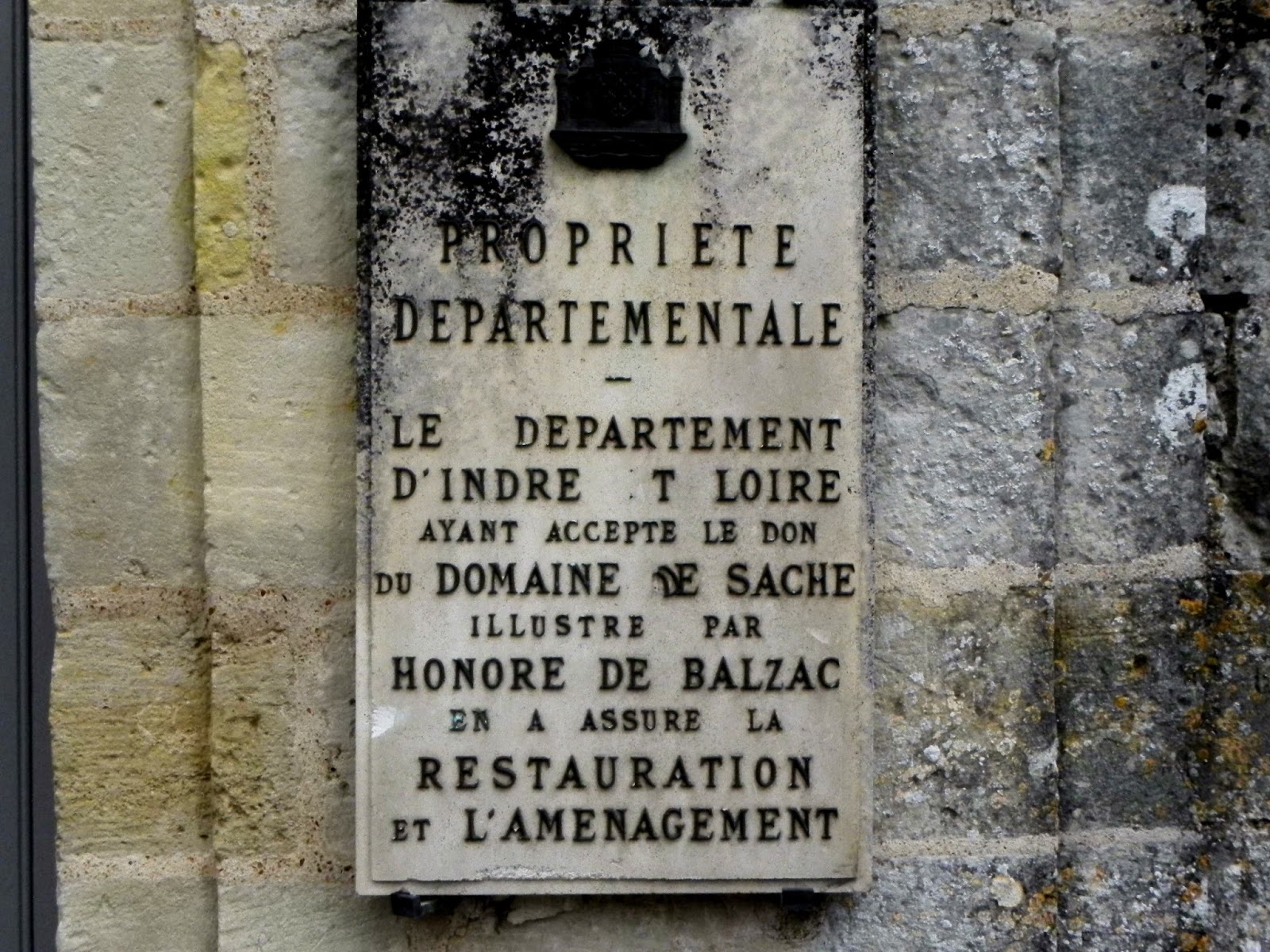
Sache is a small chateau whose claim to fame is Honore de Balzac.  He didn't own the house, he just visited often, using it as a place of retreat to write.  The house is used as part museum and part art gallery.  There is little of Balzac here, except for a small room with several of his handwritten manuscripts.  It does give an overview of his life, though.
Soapstone stove in the dining room.

The chateau from the gardens.


The grand salon.

Alliums in the garden.

A huge oak tree had fallen and was in the process of being cut up for use.


Lilies

Balzac as seen through the eyes of Rodin.
Sache is one of those places we would probably never have visited except it was included, at a discount, when we visited Azay-le-Rideau.  Several lesser known historical houses use this method of increasing the number of visitors they receive.  It worked with us!

Bill's Morning Walk to Chateau du Chatelier

The donjon at Chateau du Chatelier, built in the 12th century.

Several mornings a week Bill goes for long walks.  When he heads west from the house he passes through the small village of Paulmy and then on to Chateau du Chatelier.  Whenever one sees a large square rock building on top of a hill, you know it's a ancient donjon.
The arches are now the entrance road, but it used to be a draw bridge.

A moat completely surrounds the estate.

The back entrance arches, where the drawbridge is still used.
He crossed the front bridge, walked up a ramp between two rock walls, then entered a courtyard to finally view the front of the chateau.  There are several outbuildings; barns, stables, workers homes, and a large building called the Protestant Grange which is used for concerts.
The chateau is privately owned, but as long as you are polite and do no disturb them, you may walk around.

The new part was built in the 17th century.  Get your head around that for "new".

Wednesday, July 31, 2013

Gallo-Roman Ruins, Here We Come

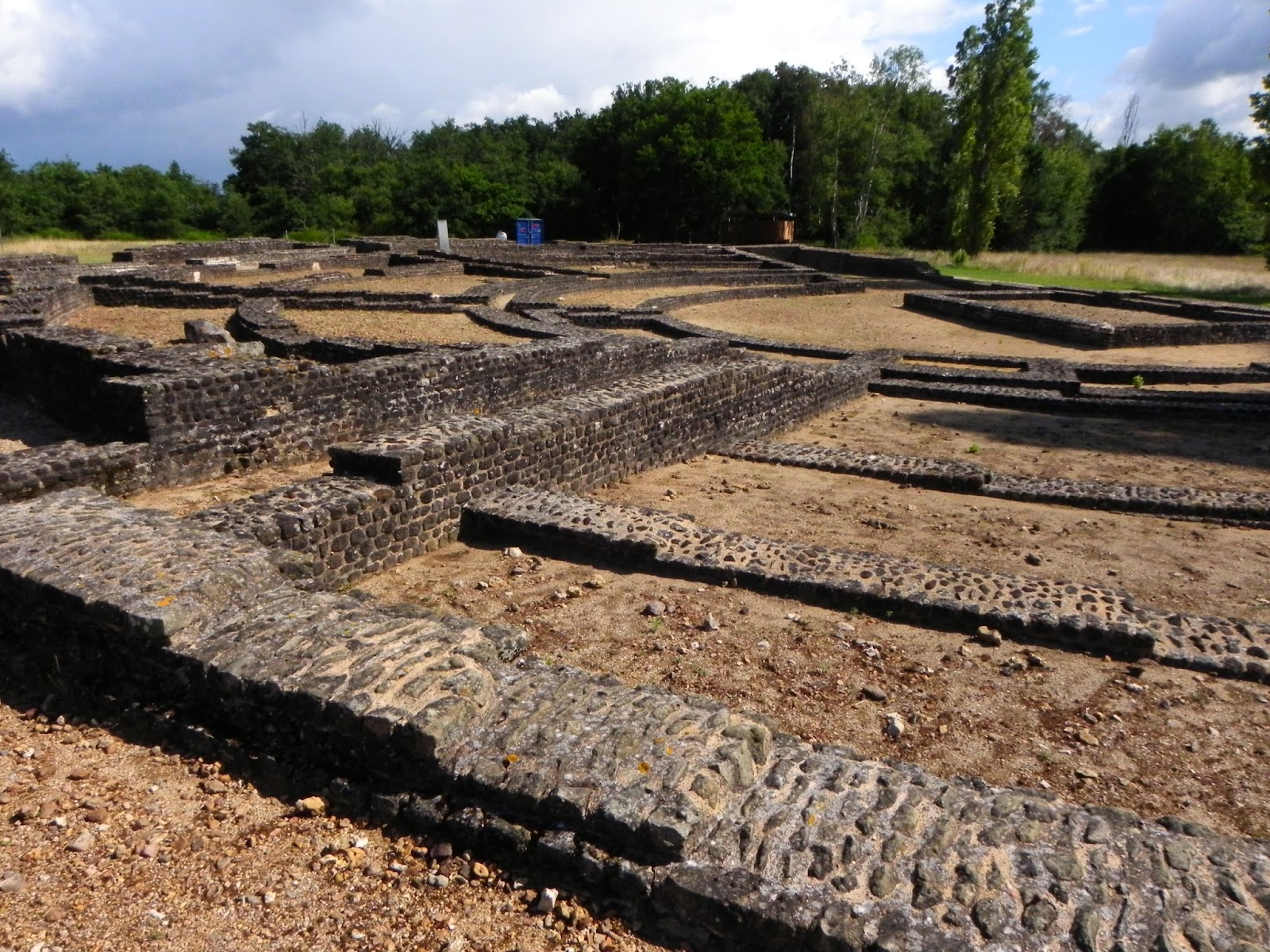
A theatre, which originally had 15 M high walls at the rear, with seating for 3000 people.
The first time we tried to visit the Gallo-Roman ruins near La Lude, the serpentine belt on the car started fraying, so we returned home instead.  Now, with a new belt in place, we were ready to venture forth.  Bill looked at Google Maps to find a direct route on larger roads, so the trip there would go quicker.  Unfortunately, it didn't show the road construction deviations.  One was so awkwardly signed, that a policeman was standing in the middle of an intersection talking to each car and sending them in the correct direction.  We showed him our map, to which he pointed with his key,  "C'est la, la, a la"  We answered "D'accord" and went on our way.  Driving in France is always an adventure!

Always fun to imagine how it must have looked when new.

The site included a forum, theatre, large temple and baths.  You could also see the underground aquaduct that fed the baths from a spring 3k away.  Archaeologists have been working this area for 35 years.  The ruins are surrounded by farmland, some in hay and some used for grazing.  Since this was someones farm before being dug up, the farmer still has use of the land. The hay had been cut and baled.  On the other side of a fence from the site, the owner was separating his cows into two fields, with much yelling and running.  The cows were very interested in what we were doing.   One field included a bull who was more than ready to do his job of insuring a new generation of cows.

I am the Bull!
Since we had no plans other than going to the SuperU in Descartes on the way home, Bill programmed BiB to take us there, by any way she wanted.  We traveled on small roads, past fields of wheat, bales of hay, sunflowers, tree farms and onions.  The villages were small and deserted, since it was lunchtime; everyone was eating except us.

A field of onions grown for seed.
While in the SuperU in Descarte, there was a tremendous downpour.  By the time we had finished with our shopping, the sun was shining again.  Our weather for the past few days has been this way.  So far, we have missed getting wet.

Blackness Castle and Linlithgow Palace

Two castle built during the same period, but for completely different uses.  Blackness Castle was a military fort on the Forth of Firth, whi...