Sunday, July 11, 2010

Of Birds and Birthdays, Saints and Librarians

Maghera is a small town about 15 miles from Kilrea, or if you take the wrong exit off the round about, 20 miles.  The benefit of taking the road less traveled is meeting more of the locals.


The pheasant wasn't the least bit concerned as soon as we stopped the van and turned the motor off.  He didn't even care that I opened the door so I could take his picture; even seemed to pose for me.

When we arrived in Maghera, we found the church we were looking for, but couldn't find the gate in the tall stone wall.  What to do?  Go to the library of course.  Librarian know everything, or at least where to find it.  She made a phone call, then sent us to the Leisrure Centre, but not before making sure we knew how to get there and back to the church gate. I love librarians!


After dealing with the traffic twice through town, we decided to leave the van at the Leisure Centre and walk to the church.  The gate was padlocked with a large chain, the door to the still enclosed part of the church had a deadbolt lock.  It is a strange feeling to have the keys to a National Heritage site, given with no ID, just sign the book and put down a phone number.

St Lurach's church was founded in the 6th century, plundered by the Vikings in 832 and burned in 1135.  After being rebuilt, it became the seat of the bishop from the mid 12th  through the mid 13th centuries, when it was returned to a simple parish church until the new building was erected across the street in 1824.  Now it is a shell, except for the tower which was enclosed in 1994 to protect a Romanesque carved doorway.  It is very elaborate, with Christ on the cross, the two thieves, the 12 apostles and angels flying over.  The side decorations are interlace, floral and animals.  All of this was carved when the church was rebuilt after being burned. 


The graveyard is upheaved and uneven, with the headstones leaning every direction.  Most of illegible due to weathering, but we did spot St Lurach's near the back.  The circle cross is still faintly visible.

We returned the key, and took off looking for a dolmen, which actually had a sign and arrow from the road!
It isn't in too good of shape as one of the side stones has split, so someone had added cinderblock and wooden shims to hold the roof in place.
Our van with the dolmen sign.


We returned home after looking for a grave which refused to be found. Then we went for dinner at Arbutus a local Kilrea restaurant. When we arrived back at the house, the Irish were still at the dinner table. Discovering it was my birthday, they gave me a wonderful gift of a song about a fair in Balleycastle. All in all a great birthday!


Anne
Henrietta aka Henry
Maria

Give Us A Sign!

Ireland is full of wonderful sites that are impossible, or very nearly, to find.  Sometimes it's because they are in the middle of a field of cows.  Sometimes it's because the folks who work on the roads forget to put up the signs when they close the freeway down.
Imagine driving along the M1, the main freeway route from Belfast to Dublin.  The orange cones start to appear, along with signs to merge left into one lane.  You exit to a round about, then there are no more signs for where to go.  All the traffic from both directions on a 4 land divided road ended up in the small town of Newry, which has a river running through it and only  two wee bridges across the river.  Some of the corners were not built for lorries to turn, so they had to pull way over then squeeze around, in some cases having to back up and try again.  What a mess, the entire town was constipated with vehicles.  After going in circles several times, we finally made our way out of the town, not exactly where we had hoped, but at least we escaped!

Driving out into the country, we finally found the little road we thought we were looking for.  Several signs later, the last one being in a front yard, we thought we had arrived.  But, the stone was no where in sight!  I looked at the sign in the front yard again, just in case I had missed an arrow, but no.  Then a van came down the road, so I flagged them down, and asked the driver where we could find the stone.   "See that gate there, go through it.  See the next gate on the other side of the field, go through it.  Then it's on the other side of that field.  You're very close to it!"  Maybe they should just put up an arros!

We had brought Shiva with us for the day.  She was not having a good time, so far, being stuck in the back of the van.  Things got better.  Through the first gate, and down to the second, when we realized the next field was full of cows.  Shiva looked at them and they looked at her.  Bill went through first to make sure it really was the right field, as we couldn't see anything resembling a standing stone.  When he came back into view, he had found it.  Shiva and I came into the field when all the cows suddenly came toward us, in a herd! 

Bill really missed the best picture of the day.  As the cows came very close I stopped to see what was going to happen.  Then one brave soul came forward, stretching her neck way out to get close to Shiva.  Shive responded by stretching her neck until she and the cow were nose to nose.  They stayed that way for several seconds, then each pulled back and looked as if to say,  'Oh, it's just a cow'  Oh, it's just a dog'.  We walked on to the the other side of the field, though an opening in the fence, with no gate, and there was an area with a tall hedge grown around it, accessable by a small gate.  Inside was the stone.


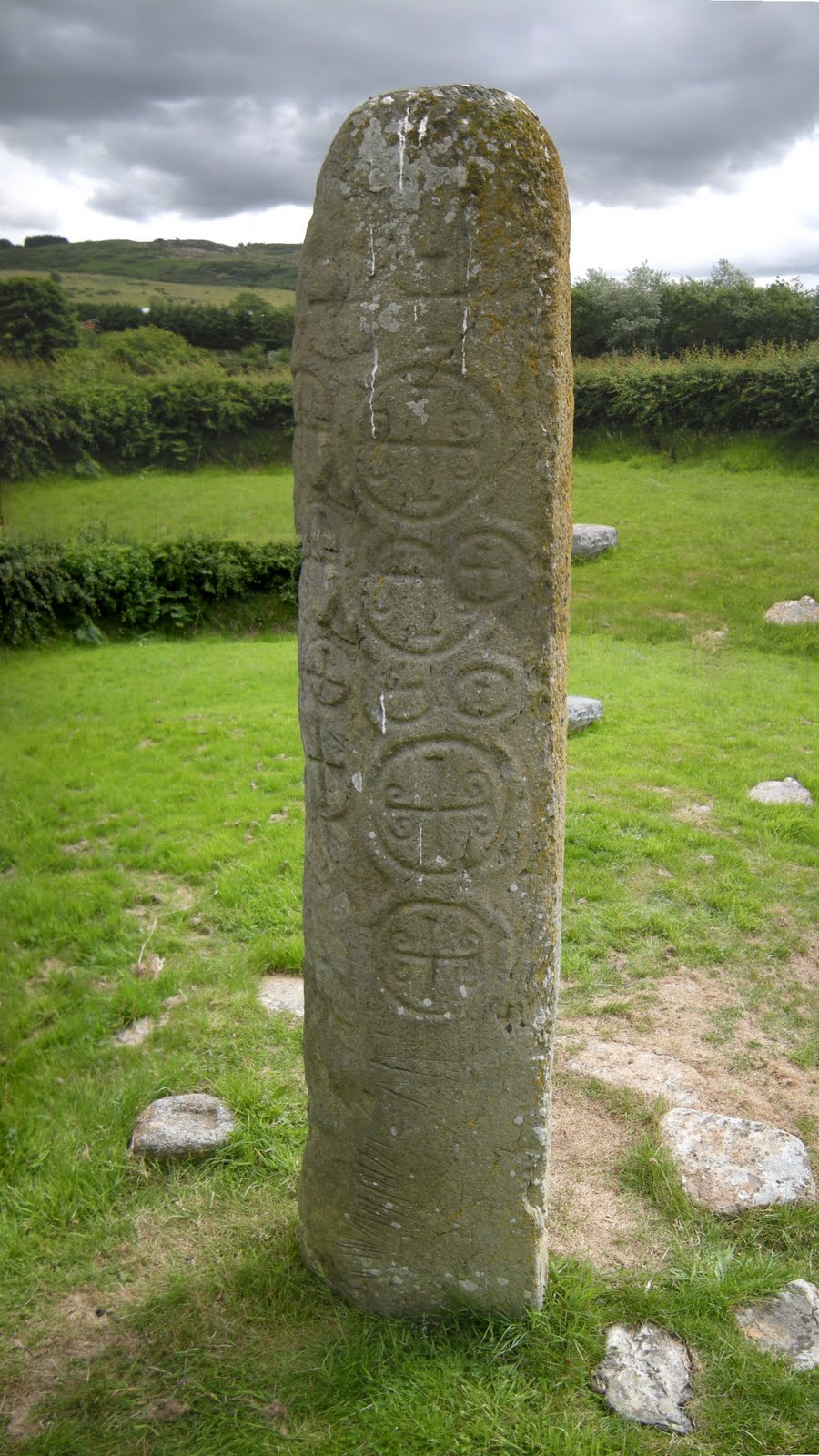
Kilnasaggart Stone is the oldest dated Christian stone in Ireland.  It has a long Irish inscription recording the dedication  of  the place bt Ternohc son of Ceran Bic.  Ternohc death is recorded in either 714 or 716, and the stone can be dated to about 700.  The smaller stones around the pillar have crosses carved on them and may have been gravestones.

Leaving here, we followed more signs to Moyry Castle, which isn't a castle at all, but a fortress designed to secrue the pass below.  It is a small 3 story square, with gun ports faceing every direction.  It was built in 1601 by Mountjoy when he was fighting the O'Neills.

At the castle we met a young couple with 3 sons, having a picnic.  They had been looking for the stone as well, but when we told them they had to walk through a herd of cows, they weren't interested.  Their oldest son, who was about 10, kept looking at Shiva.  Then he finally asked what kind of a dog is that?  When told she was an Irish Wolfhound, he said he had only seen the grey ones, and she was much prettier.  He ran his had across his chest at his shoulders, the height he thought Shiva was, then rolled his eyes and said 'She's very big!'  Oh yeah!

Before we take either of the dogs with us again, we need to attach some padding to the wooden floor of the van, so they can have traction for traveling and sudden stops or turns.  Shiva was pretty stiff by the time we arrived home, as well as the next day.  But, now she is ready to go again!

Saturday, July 10, 2010

Navan

There are times when we head off to a place, not really expecting much, only to be totally amazed.  So it was with Navan.  The guide book described it as a man made hill, built by the celts under the direction of their druids.  The visitor center was no longer opened.  An hour to see the place, tops.  Wrong, wrong, wrong.

The visitors center is not only opened, it's a new,earth bermed structure with a great interactive hall telling the history of the place, as well as early Ireland. They even have the skull of a Barbary ape that was found during excavations. The ape arrived here around 500 BC, evidence of the wide trading that was done by the locals.  Plus, there was a delightful cafe where we had lunch.


Outside, they have built a model of an early Christian era dwelling, which is inhabited by docents who are very good at their jobs.  They stayed in character, as people living in 380 AD, explaining how they made their house, grew their foods,  raised their children, even some of their beliefs.  They asked if Bill was a druid because he had a long beard and looked very wise.  I almost laughed outloud!

Wicker man's head and torso, the arms are leaning against the fence.

They are building a wicker man to burn on Lunesa, complete with a sacrifice inside.  When we left the village, they gave us a small hand full of barley to offer to the god, Lu, when we arrived at the top of Navan.  Lu is the god of sunshine.  We made the offering, but so far, it's still raining.  Bill thinks we needed more barley.

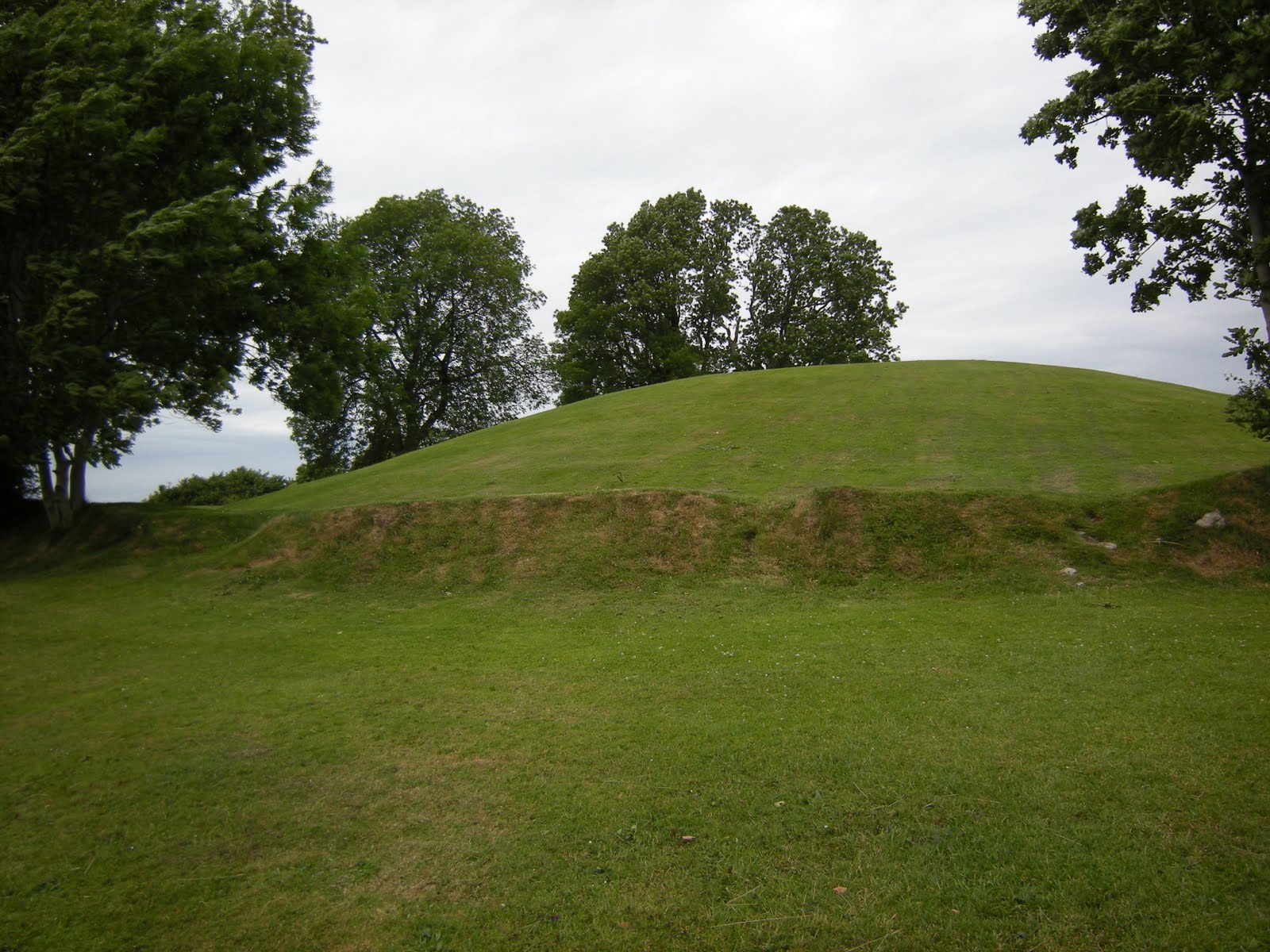
The walk to the base of the hill was about a quarter of a mile, then we went up, up, up.  This site was most active around 100 BC when a 40m across round building was erected and filled with stone.  It was then burned and covered with soil to make the beautiful dome we see today.   The skirt walls were 3 meters, with the top of the domed area being 15 meters high, all on top of a hill.  Great views.  I can understand why this would be a good place for gatherings and talking to the gods.


To give you an idea of the size, since it doesn't really show in the picture.  This is a tree we could see from the hill. 
Me sitting on the tree trunk.  It's a big old tree!

Thursday, July 08, 2010

Dresses, Hats, and Dummies

This house sit has been really different from our others.  Maria and Dennis are still here.  It wasn't supposed to work out that way.  Dennis was supposed to be working in Afghanistan. Maria was supposed to be busy with contracts in her business.  Sometimes life doesn't go as it is supposed to.  So, we take care of the dogs, visit Ireland, cook supper semi-regularly, help out when we are needed, and in general have a good time.

Maria and Dennis are planning on moving to Phoenix, Arizona by next year.  This means they need to sell all the stuff in the house and business.  Maria has some beautiful vintage designer label clothing, as well as some fab hats.  She has been listing them on ebay, but not having much luck, so she found a dummy, to use as a model.  We decided she was a French dummy, so her is Duminique.


We spent most of one day doing photos.  I pressed the clothes, Maria and Bill dressed Duminique, then Bill took the photos while Maria wrote down all the info she would need to list them.  Dennis made some excuse about grouting the bathroom.  He would come out every once in a while to find out why we were laughing so hard.


Duminique really shows off the dresses.  Her arms and torso are removeable for easy dressing, or if the clothes are just a bit too tight.  She has several different wigs, depending on the mood.  Sometimes the only thing to do is go for the armless, cueball look.


She even looks good in an Elvis wig!

A few days later, Maria came up with a large collection of hats.  She was looking for a purple one, but though we searched high and low, we couldn't find it.  Then the next day, I was in the garage, when a large box labeled 'purple hat' popped into my field of vision.  Nothing to do but unpack it for showing.  I'm not as cute as Duminique, my arms don't come off at will, but my hair is my own!  So are the wrinkles!


All of the clothes, plus many others are available on ebay under designer clothing.  The hats we trying to sell locally.  Wonder if this one would fit in my suitcase?

Wednesday, July 07, 2010

Release The Hounds!

Irish Wolfhounds are huge, hairy, loyal, protective and very deadly if you happen to be a wolf.  In 1724, the Irish Government proclaimed that every county should keep a pack of 24 Wolfhounds to kill the wolves.  This must have been very successful, as there are no wolves left in Ireland.  Unfortunately, this was almost the end of the Wolfhound, as well.  Who needs to feed a huge animal that is no longer needed?  In the 1800's, breeders, realizing tha potential demise of the breeed, worked to turn things around for Wolfhounds.  The result of this concern is why we are in Ireland.

Meet Morgan and Shiva.
                 Morgan getting his morning rub.


                                          Shiva the Goddess

Morgan is a huge male, with the disposition of a teddy bear.  Shiva is a regular sized female who rules the roost.  We take them for walks every morning down by the River Bann.  When we first arrived, they were both extremely overweight and moved slowly.  We have cut back on their rations and upped their exercise levels to the point that now, after nearly 4 weeks, they are both running and bouncing during our walks.

Thursday, July 01, 2010

Lazy Day


We didn't want to stay at home. We didn't want to drive very far. Off to the North coast it was!
Besides we were low on Bushmill's and it's so much cheaper at the Distillery!


We were headed to Port Stewart, but were sidetracked by the B & Q in Coleraine. Think Home Depot with an Irish accent. It's main color is even orange! We managed to escape without buying anything, although some of the bathroom fixture were amazing.
Arriving in Portstewart, we were amazed by the number of people. Most of them older than us! Parking was scarce, especially for our van, but we finally found one right on main street next to the Promenade.


The sculpture, a combination viking boat and fish with a shell in its mouth, was in honor of the man who wrote "Red Sails in the Sunset".

Bill loved the seawall with all the boats. He walked out on it, but I wasn't feeling that adventurous, so I stuck to the land.


On around the coast through Portrush, a busy area in the summer. The place has acres of Holiday Caravan Parks, which can be rented by the week or month. It has been a holiday destination since Victorian times. Not my cup of tea, though.

The views from the road on to Bushmills are brilliant. There was even an information board letting us know how the cliffs were formed. That was very thoughtful, don't you think?


Then we headed back to Coleraine to find another neolithic fort, Montsandal. After a disagreement with BIB we finally made it to the carpark. The fort was a .6 mile walk through beautiful forests, part of a city park. The fort is a very tall mound of dirt with a steep sided bowl in the center. The locals say it was a gathering place long before the Normans came to make it a fort. It has not been excavated by archeologists, but a small part outside the fort was studied showing it had been inhabited over 10000 years ago, just after the last ice age.


Wednesday, June 30, 2010

Grianan Ailligh


On a cloudy day, that felt like rain, we drove up the small road to the hilltop where Granan sits. It is a round stone fort, although the ancient tradition calls is a meeting place. The lairds would come for conference, bringing their men at arms, because from Granan one can see for miles in all directions. Each laird would arrive from their own direction and could watch to see that there was no ambush being planned. Today we weren't worried about ambush, just thrilled at the 360* view. This is truly an island of water!


The stones which make up the Granan are black, but occasionally have a piece of quartz. The fort is 77 ft in diameter. It was likely built aroung the 5th century, BC. Tradition says that St Patrick baptized Owen O'Neill, the founder of the clan, here in 450 AD. The O'Neill's lived here until the 12th century when it was damaged by the army of Murtagh O'Briean, King of Munster.


This is another one of those magic places, just because it has been here so very, very long.


Farther up the Inishowen Peninsula is the village of Cardonagh, home of a 7th century cross. It is carved with human figures and, at least to my eyes, Celtic designs. There are two little posts on either side that are supposed to be David as the slayer and David as the poet.


Blackness Castle and Linlithgow Palace

Two castle built during the same period, but for completely different uses.  Blackness Castle was a military fort on the Forth of Firth, whi...