Sunday, August 23, 2015

Discover Dornoch

The sarcophagus of Sir Richard de Moravia, brother of the founder of the cathedral, St Gilbert. Sir Richard was killed in battle about 1240.
Dornoch has a market on Wednesdays during the summer.  They published a nice brochure for folks to pick up, telling about all of their markets, sales, festivals and fairs during 2015.  It's a busy little town.  We decided to go the Wednesday market, just for comparison with other markets in other countries.  What we found was an interesting town with a beautiful cathedral and a small market where they were trying to raise money to build a new community center.

Not sure what this is for, but it was made in 1790.

The cathedral was built by by the Bishop of Caithness, Gilbert de Moravia, at his own expense.  It was consecrated in 1239.  The Bishop was the last Scot to be given a place on the Calendar of Saints. The cathedral has gone through several renovations, helped along by several wealthy patrons, including Andrew Carnegie in 1893 (installation of the organ) and 1908 (renovation of the organ) and his daughter, Margaret, (renovation of the organ) in 1979.  Andrew Carnegie stayed each year in Skibo, 6km from  Dornoch, and worshiped here.


Yes, that's right, the American industrialist, Andrew Carnegie.

Just hanging around the outside of the cathedral.
Dornach has always been a market town.  To one side of the graveyard is a pladen elt, a stone used to measure tartan to be cut, so the merchant wasn't able to cheat the buyer.  Originally, the market was set up in the graveyard, with the tables and stalls set over the graves.  After a wall was built around the graveyard to prevent damage by roaming pigs, the market was cut in half and went into decline.

Celtic cross in the graveyard.

The stone where tartan material was measured for cutting and selling.  This insured the buyer received the true amount.
The market the day we were there, while small, had quite a bit of variety.  All of the items offered were local, from handcrafted pillows, clothing, and purses, paintings and photography, baked goods and gorgeous cupcakes, candy, cheese and, our favorite, the man selling pork pies and home grown vegies.  The pork pies had been baked the day before.  He grew the pig, his wife made the pies.  We had it for dinner with roasted vegies.
Wednesday market on the Cathedral green.

Front entrance to the cathedral.
 Walking around the village, it's obvious much care has been taken to preserve the old buildings and when new ones are added, to have them built in a matching style.  It is paying off, as tour buses have Dornoch on their itineraries.
Old buildings, new tour bus.

Walking his pony to the market. 

We browsed in an antique shop, knowing we wouldn't be buying, but enjoying the look.  Then ate our lunch before heading home.  A good day!


Friday, August 21, 2015

Seaforth and Cameron Highlanders Museum

Recruiting poster for the Seaforth Highlanders; looks like a fun time!
The Seaforth (1778) and Cameron (1793) Highlanders were separate units until 1961 when they were joined together as the Queen's Highlanders.  In 1994, the Gordon's joined them to become The Highlanders. Their museum, which is inside Fort George,  follows the units through all the wars fought by the British from 1778 until the present.

Souvenirs from Berlin, including a piece of Hitler's desk.
They fought valiantly during WWI, many of them dying in the trenches. Then, they were part of the troops who took Berlin, after fighting there way across Germany.  There is much memorabilia from both wars on display.
Ram's head cigar humidor in the dining room.
While the dining room here isn't as "fancy" as the Gordon's, there is a Ram's head with jewels and silver which is quite impressive.  I wonder if they passed it around to get cigars or if they just walked up to it?


The dining room, not as fancy as the Gordon's, but still impressive.

There is a nice collection of drums from the Highlanders.
The recruiting posters for both regiments seemed to appeal to having a good time.  They included drawings of young men playing rugby, tossing the hammer, dancing and dressed in their finest kilts.  I'm sure the reality was something quite different during times of war.  Many of the regiments spent years as POW's of the Japanese and built the Burma Railroad.

Recruiting poster for the Cameron Highlanders.
One of the requirements to be a Highlander, is knowing how to Highland Dance.  Even before major battles, when there was a big dinner, the Highlanders were expected to dance.  Quite an oddity, I think.

Fort George

Welcome to Fort George.
After Culloden, the English set about building forts to keep the Scots in line should they decide to try to put someone else on the English throne.  Fort George, Fort Augustus and Fort William were built during this time.  Fort George is still an active army base, with warnings that you may be searched upon entering, but we weren't.

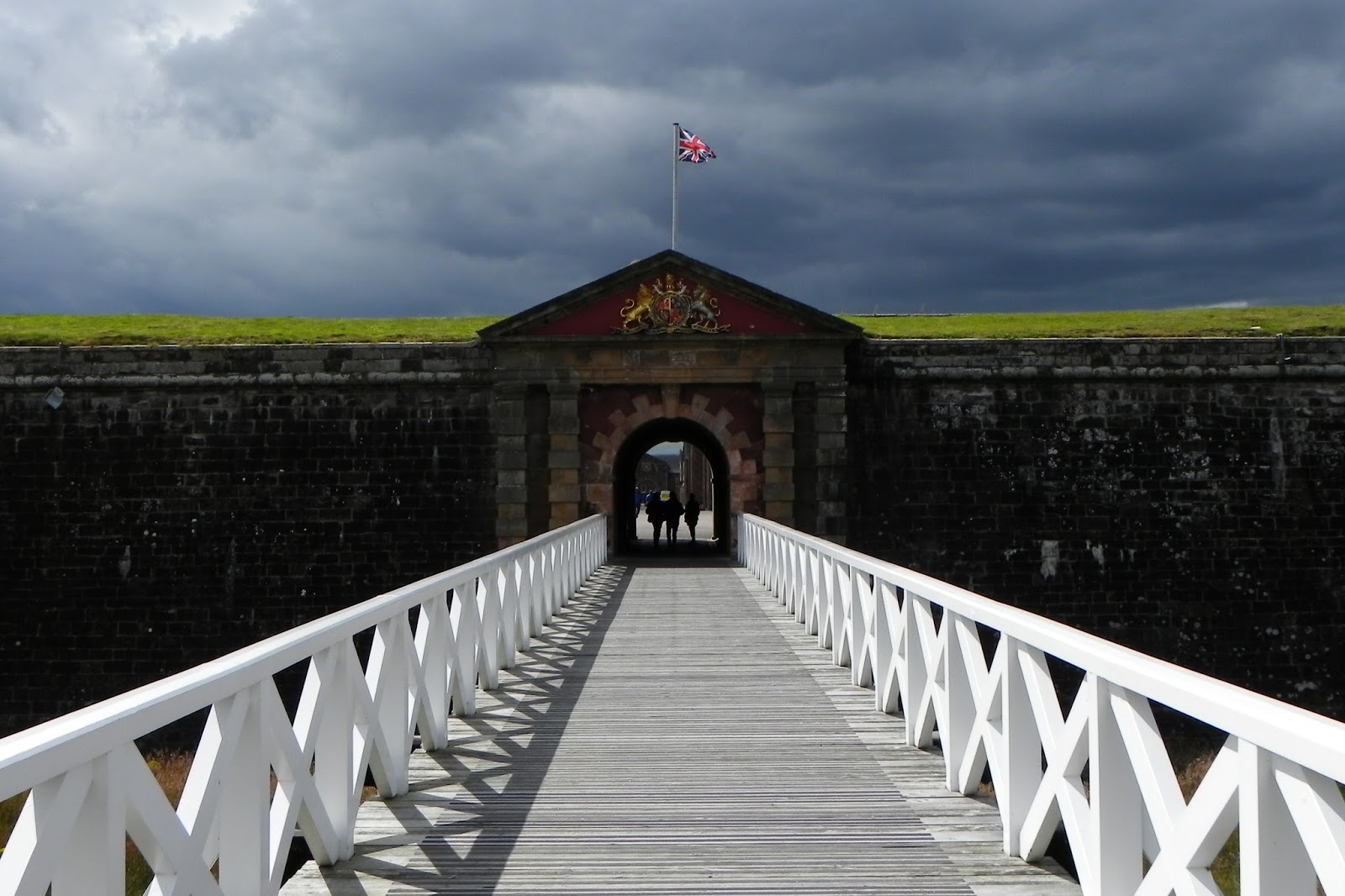
The original plans had the fort built in a star shape, but years of use and remodeling for modern guns and armament, have changed the shape a bit.  However, you can still see much of the star.  It is built with two walls, with a deep, grassy moat inbetween.  The tops of the walls have grass growing on them, as well.  On the inner walls, to reach the top, one walks up a grassy ramp.  There are no protective barriers to the inner area, if you get too close to the edge, you fall!

Draw bridge leading from the outer fortifications into the central walls.

The English Royal Arms, but not quite.....
the explanation: they have the
Arms of Scotland wrong.
In the Grand Magazine is a wonderful collection of arms, military clothing and shoe buckles.  One interesting little tidbit; shoes were not made for left or right feet, but were the same, so the wearer would change which foot they were worn on, to keep the wear patterns even.  The things one learns.

The Grand Magazine would hold 2800 barrels of black powder.

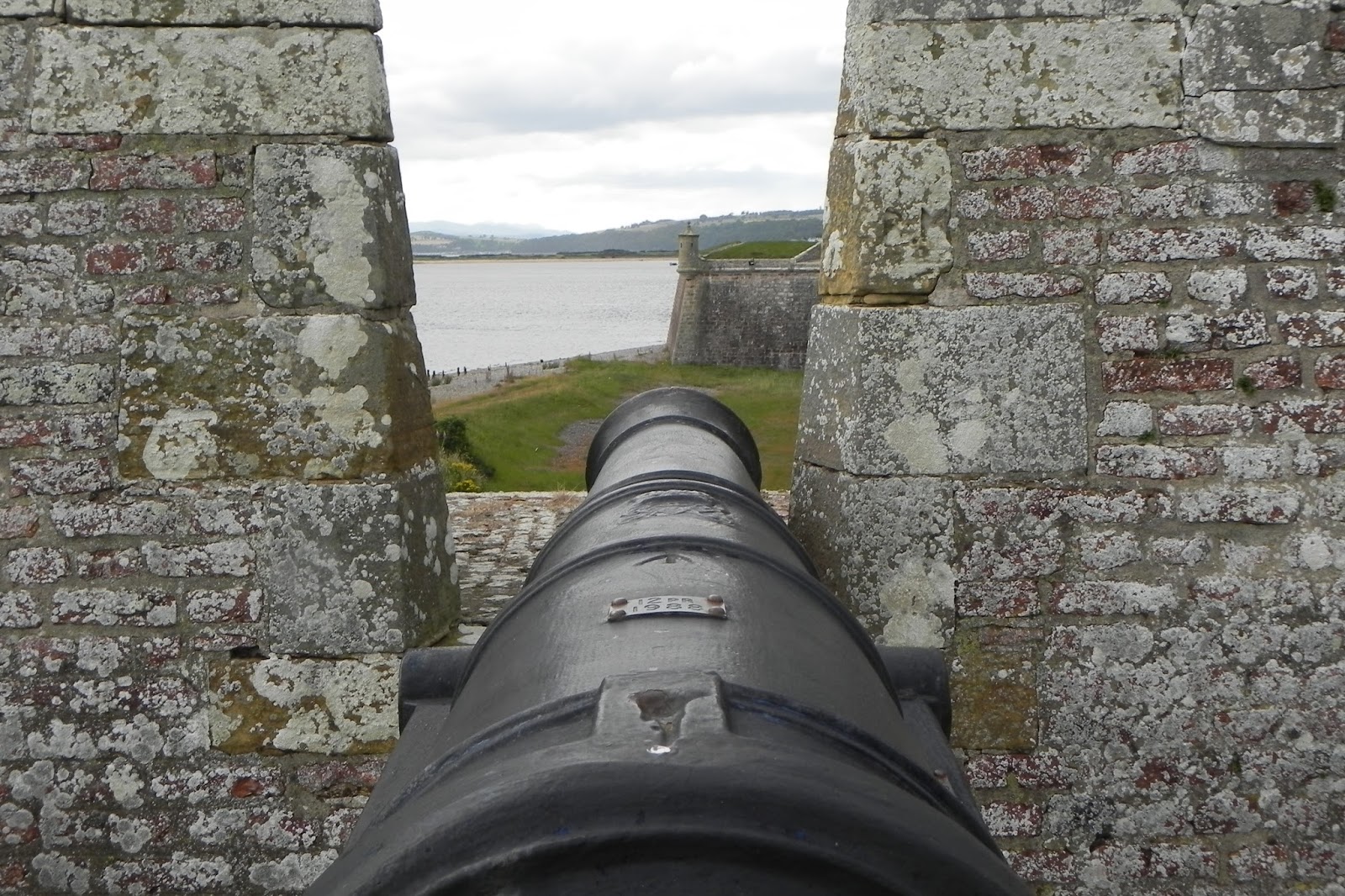
Cannons are in place to guard the Firth.  I don't believe there are any cannon balls, however.
The fort is still an active Army base, which was a little odd.  We would be walking around looking at historic items, when someone in full uniform would walk by.  There were barracks where boots were set out on the window ledges to air and modern music was playing inside.  Several areas were off limit to tourists, too.  I'm not sure what the Army does here, but it surely involves protection or warning of invasion from the North.

It was very cold and windy on the walls.

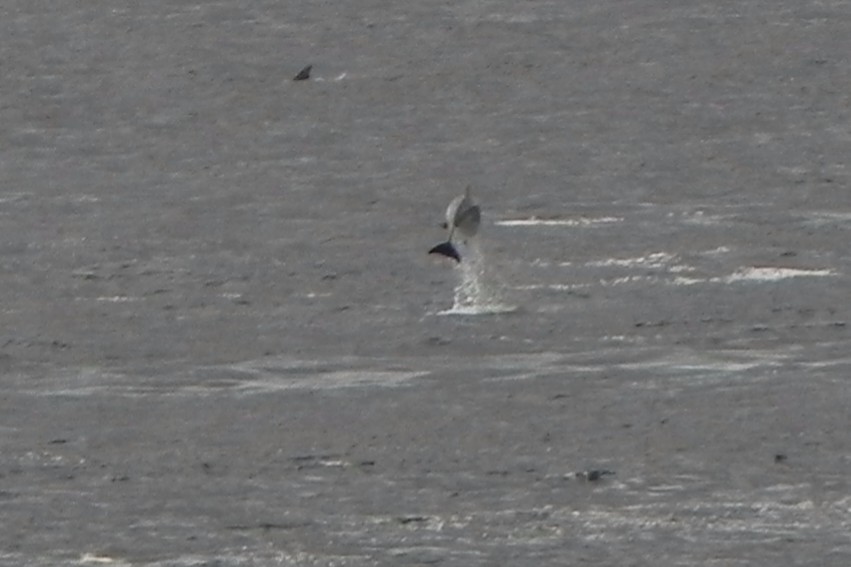
We have been looking for dolphins since we arrived in Scotland and learned they lived here.  We finally found them swimming off Fort George in the Cromarty Firth. They put on a show which we watched for about 20 minutes.  So glad we were able to find them!  Now to keep looking for a whale.   Perfect!
Jumping out of the water!

You can see the whole Dolphin.

Look closely, there are two of them playing here.
On our way out, we found the main gate guarded by Scots; barefoot, of course! Quite a lovely pair, with a third little one hiding to the left of her big sister; you can see her long blonde hair.  They were having quite a lovely day, as were we!
Scots on the battlements!

Thursday, August 20, 2015

Culloden Battlefield


Welcome to Culloden Battlefield.
The battle at Culloden, April 16, 1746,  was the end of the Scottish attempt to bring Charles Edward Stuart to the throne of England and Scotland.  It lasted just over an hour, with 1500 - 2000 Scots killed in just a few minutes, while the English casualties were only 50, with some 250 wounded.  While they both had cannons, the English were better trained in their use.  The English Army could also load and fire their rifles at twice the speed of the Scots; again better training.  The Jacobite Rebellion completely collapsed.

After the Scots retreated, Charles went into hiding, finally escaping to France.  The Scots were systematically slaughtered by the English as traitors who deserved no quarter.  For many years the wearing of tartan was banned, clans were banned and being Catholic was banned.  It was not a good time to be Scottish, unless you had sided with the Crown.

Stones mark where different groups were buried; this is for the English.

A small hamlet was on the sight of the battle, this house is all that remains.
After the battle, the dead were stripped of all clothing and belongings and buried in mass graves.  For many years, items that were purported to be from Culloden were sold in the markets around Scotland. In 1884, Duncan Forbes erected a 20 ft tall memorial cairn and several headstone to mark the mass graves of the clans.  Recent archaeological excavations, topographic, geophysical, and metal detection surveys have revealed more information of the fierceness of the battle.  Shattered pistol and muskets, bits of sword and knives all point to close quarter, hand to hand combat, with mortar shells firing grapeshot; a deadly combination.

The hilt of a sword found on the battlefield.

A knife with sheath known as the "white knife of Dal Mhoraisd"  The Stewarts of Dal Mhoraisd in Glen Tilt followed Lord George Murray in 1745.  This knife was reputedly taken by one of these Stewarts from the breast  of a horse on the field at Culloden.

There is a newer visitors center with wonderful displays and graphics, looking at the build up to the battle and the aftermath from the perspective of the Scots and the English.  There are also many oral readings taken from the writing of the survivors.  A short movie, in surround screens, gives a feeling of the overwhelming odds against the Scots. All of this before you go out onto the battlefield, so it makes more sense when you are walking the field.   We really enjoyed our visit, and learned a bit more about the history of Scotland.


Tuesday, August 18, 2015

Inverness on a Saturday Afternoon

Looking over the River Ness.

We decided to drive into Inverness on a Saturday afternoon.  At first we thought we would take the train, but after looking at the map, drive we did.  Traffic wasn't too heavy and we found our parking area with no problem.  Yea!

The walk along the River Ness is quite lovely.

 Walking along the River Ness is really the way to see Inverness.  There are many old buildings, the river is peaceful, and there is always something to see.  A statue of the Three Virtues, once in a church, is now in a small park. Across the river are many delightful old buildings.
Faith, Hope and Charity who are now in a park instead of on top of a church.

Spanish Tapa Bar, Ole!
 The Inverness Castle is on top of the hill above the river.  It was built in the Victorian era and now houses government offices.  So, it seemed a bit odd when we discovered the statue in front of the building is of Flora MacDonald, the woman credited with saving the life of Bonnie Prince Charlie when he was fleeing from the English after his defeat at Culloden.

The statue in front of Inverness Castle is Flora MacDonald, who saved Bonnie Prince Charlie from the English.   The engraving reads:  "a name that will be mentioned in history, and if courage and fidelity be virtues, mentioned with honour."
The Inverness Museum is just below the castle.
 The Inverness Museum is free.  It has a small, but well done collection ranging from natural history to art.  The thing I found the most interesting was a wall where one could push a button next to a saying and hear the words in Gaelic.  I played with that for a while.

Pictish Bull

Pictish Wolf
It wouldn't be a Scottish museum without Pictish stones.  Here we were allowed to make rubbings of the stones from wood blocks with the carvings ingraved on them. Bill and I each made one.  When a couple of other adults realized what we were doing, they came over to rub one too.

The first edition of the Gaelic Bible printed in 1690.
 Out of the museum and on to the High Street, we found a whisky shop selling every kind of whisky you might want.  It was also playing a live concert recording of Johnny Cash, with several guest stars.  Not what we were expecting to hear in Inverness!
While being refurbished, the Town Hall is covered over in sheeting printed to look like a curtain pulling back to reveal what the finished building will be.

Abertarff House, built in 1593, is the oldest secular building in Inverness. It was the town home of the Frasers of Lovat.  Belonging to the NTS, it isn't opened to the public.
 We wandered on down Church St and tucked in behind the buildings was Old High St Stephens and it's graveyard.  I love finding places like this.  There were several people walking among the stones and one young woman with her dog, having lunch.  A peaceful place to spend some time.
Church of Scotland, Old High St. Stephens

The graveyard had many old tombstones.
 The folks from Newtonhill, Rae and Marty, told us to find Hootananny's because they had live Highland music.  The gentleman at the museum told us how to find them, at the corner of Church and Fraser St.  We arrived just in time; there is a Saturday afternoon Caleigh.  In we went, I had a Black Island Ale and Bill a coke. (Remember, Scotland has a zero tolerance for drunk driving!)

Best Highland Music In Inverness.
 The music was fun!  One young couple from Canada requested "Loch Lomond" and when asked why, said it was their honeymoon.  Now that got the crowd going!  When the band started playing, and older couple went to the newlyweds, took them out on the dance floor and showed them how to dance.  It was wonderful!


August Schedule of Bands.
 We enjoyed the music, the dancing, the people watching and the singing along. Some of the songs I even knew the words to!  Thanks for the excellent suggestion, Rae and Marty!
The Victorian Market
It was starting to rain as we made our way from Hootananny's to the Victorian Market.  It's a building built in the late 1800's with wonderful iron work holding up the roof.  The rain had gotten heavier as we made it back to our car to drive home.  All in all, a fun Saturday afternoon in Inverness!

Monday, August 17, 2015

Dogs at the Black Isle Show

Five month old Great Dane out and about with his terriers.
While at the Black Isle Show, there were lots of things to see and do; cattle, horses, rabbits, chickens, fun rides, food and more!  One of the things that caught my attention were all the dogs brought by their owners, just to walk around.  What was amazing about the whole thing;  there were no dog fights, very little barking and no aggressive stances. 

Two Terriers being held by their very young owner.

Most of the time, only the dogs knew I was taking a picture.

"Please!  We just want to sniff!"

This very old dog was walking with her very old Master.

Sometimes you just have to take a brief nap.

"I really don't want to look at the bulbs for sale!"

Old terrier and baby lab, not a happy combination.
Well, there was one dog who wasn't happy about the entire thing.  An old terrier was tethered with a very young lab puppy while their owner prepared to show a Clydesdale.  When an adult lab walked nearby, the terrier went into attack mode!  The adult labs owner moved him right along.

Of course there had to be a Scottish Terrier!

I could never get in front of this Newfoundland to get his face, but he was huge!

Not looking very happy, but if he could chase a ball, I bet the story would be different.

This family brought the entire crew: Border Terrier, Fox Terrier, a puppy Great Dane and an adult Great Dane; all were well mannered, but the puppy was still very much a puppy!

Blackness Castle and Linlithgow Palace

Two castle built during the same period, but for completely different uses.  Blackness Castle was a military fort on the Forth of Firth, whi...