Wednesday, October 18, 2017

Creag Phadrig

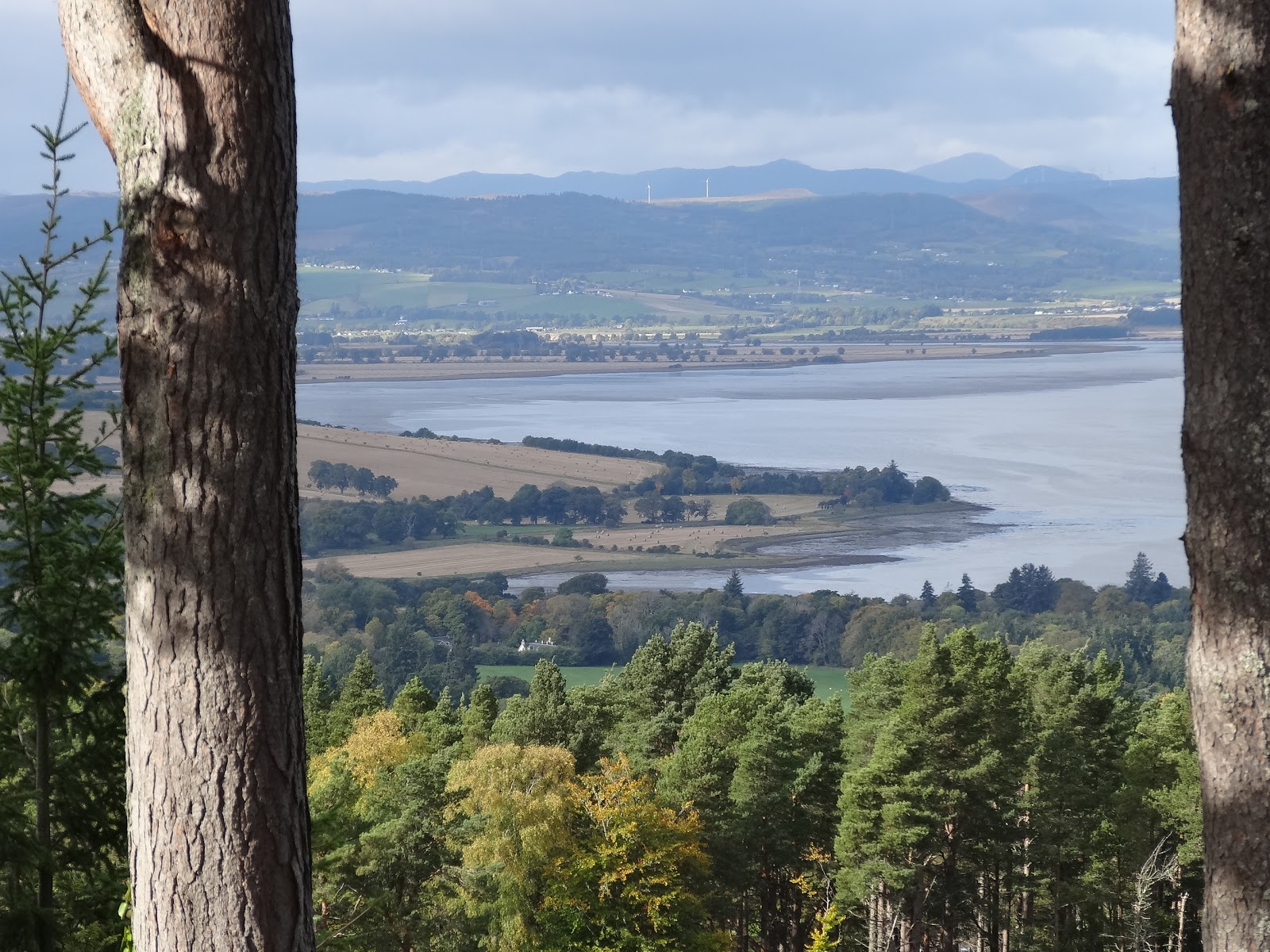
The views from the top of the hill fort were amazing.
Creag Phadrig, Patrick's Hill, is to the west of Inverness.  Tradition says it has the fort of Pictish King Bridei on top.  Excavations have shown there is a vitrified fort from the right time, 800 AD, so it could be true.  After a day of taking care of things around the house, we decided to hike the hill and see for ourselves.
Looking the other direction at Beauly Firth.

A little explanation, plus a picture of a cute Red Squirrel.
The walk up is steeper than it looks from the parking area.


The inner wall of the fort, now grown over with grasses.
We walked up and around the top of the fort, stopping to admire the views, as well as trying to figure out just where we were looking.  It would have helped if I hadn't been confusing east and west but we did identify Beauly Forth.  Things look different from on high. We walked down the opposite side of the fort from where we came up, to continue the longer forest walk.  Bill was sure we were going the wrong way, but all you have to do is follow the colors on the posts.
Follow the painted signs to make it back.
We made it back to the car park, just as several locals were arriving to walk their dogs in the woods.  We saw a couple of wild locals, too.
 A European Common Frog, although with his beautiful golden color, I think he should be named European
Royal Frog.
This little fuzzy guy was walking along the path in a hurry to get somewhere..


Tuesday, October 17, 2017

Stoer Lighthouse

Stoer lighthouse from the parking area.

It's quite the drive to Stoer Lighthouse; another one of those single track roads with passing places.  The lighthouse is no longer used, except as a holiday rental.  It's been replaced by more modern technology.
The beach below the lighthouse is too rocky to want to walk on and the hill is too steep to comfortable go down, or back up!

Lexie and I waving at Bill.

The wind was blowing a gale, but there wasn't any rain, so Lexie and I walked up to the lighthouse.  She was quite taken by the cow and sheep poop everywhere.  Water was water streaming down the hill, but I didn't feel comfortable letting her drink because of the poop.  Back to the car to share a bottle full of Inverness water.
Lexie and the lighthouse; this was a fun picture to take.

Black sheep behind a sturdy fence.  They must be special, as the other sheep are left to roam.

A local by the side of the road.

More locals, taken as we drove by.

Monday, October 16, 2017

Brochs

Dun Telve, one of the best preserved b rochs in Scotland.
"A broch is an Iron Age drystone hollow-walled structure of a type found only in Scotland.  Brochs belong to the classification "complex atlantic roundhouse" devised by Scottish archaeologists in the 1980's.  Their origin is a matter of some controversy."  Wikipedia

Dun Telve from the road.
A passageway between the two walls of dry stacked stones.


Mary in one of the entries to give you an idea of how big this house was!
We always are on the lookout for ancient sites.  While researching one at Dunrobin Castle, Bill found these two listed.  Of course, they were not as easily accessible as the one near the castle.  Dun Telve is considered one of the best preserved of the brochs.  It wasn't excavated, just cleaned out from centuries of rubbish.  The building was in fairly good condition until the 1700's when the rocks were taken to build barracks.
How they think it might have been finished on the inside.

Beautiful dry stacked stones.

Dun Troddan is not as large, but still had lots of room inside.

This area of Scotland is the only place where brochs are found.  They think is was a common building type, with the men going from one place to another to build them.  They are very sturdy, and with the roofs on would have been warm and protective.

Dun Troddan is on top of a hill.

I had to navigate the mud to get to the interior doorway. It rained the entire time we were there.

This shows how the walls lean in.
Finding these places is always an adventure. We drove on one lane roads with "passing places", until we came to a one lane track with no real passing places.  Fortunately, we didn't meet anyone.  Across the road from Dun Troddan are several homes used as holiday rentals. It would be an ideal place to spend some time.
The road less traveled.

Sunday, October 15, 2017

Enjoying Music in Inverness

Music abounds in Inverness, from the buskers on the street, the pubs with traditional songs, and Eden Court Theatre.  We have enjoyed them all.  We also meet the nicest people.
Gellion's Pub.

Lovely lady who shared her table with us.

Hootenanny's on our first visit.


"Accordian, Too" setting up to play at Eden Court.

Hootananny's on our second visit.

A Piper greeting wedding guests at a hotel on the River Ness.

Two young musicians playing on the street.  They are some of the best we have heard!

Singing her heart out.

Saturday, October 14, 2017

The Monarch of the Glen

The Monarch of the Glen is an oil painting by Sir Edwin Landseer in 1851.  It was originally commissioned to hang in the Palace of Westminster, but for some reason it never did.  Landseer sold it to a private collector.  It was a very popular painting during the 19th century, with reproductions widely sold and was finally purchased by companies to use in advertising. It became something of a cliche' by the mid-20th century "the ultimate biscuit tin image of Scotland", according to the Sunday Herald.

To my surprise, some of the companies who used the painting in their advertising are American, The Hartford Financial Services, Nestle North America's Deer Park Spring Water and Challenge Dairy in California.  In Scotland, it has been the logo for Glenfiddich single malt Scotch whisky since 1968. Thank you Wikipedia.

The Inverness museum allowed photography.

In 2017, the National Galleries of Scotland launched a successful campaign to buy the painting for 4 million pounds from it's owner, Diageo, the multi-national drinks company, who acquired it in the merger with Dewar's and Glenfiddich. It is now touring Scotland, with a stay in Inverness.


Friday, October 13, 2017

Eilean Donan

Eilean Donan Castle
 The drive southwest to Eilean Donan was beautiful. Tall mountains on either side of our road, which  ran down the flats by the river and lochs.  Waterfalls tumbled down; too many to count.  Logically, we knew the mountains weren't very high, but to be at their base and look up; they were huge.  We kept saying, "Look there!"  "Oh, beautiful!" "There's another one" "I think those are deer across the river!"
Picture postcard moments.
This waterfall started at the very top of the mountain, cascading down to the river.  There were too many falls to count.
The island was named Eilean Donan (Island of Donan)  in the 6th to 7th century after a chapel site by Saint Donnan of Eigg.  He was another Irishman come to save the heathen Scots.  There seem to be a lot of them about.
Over the door is inscribed "As long as a MacRae is inside, a Fraser will not be left outside."
 At the castle, pictures are not allowed inside, but one of the docents gave a brief talk, full of information and humor.  The castle was started in the 13th century.  As with most castles, it was added to and refortified over the years.  It was originally built to protect the lands of Kintail against the Vikings, who controlled much of the North from 800 - 1266.  Perhaps that it why so many Scots have red hair?

From 1509, John Mackenzie, through a charter from the Crown, controlled the lands of the Kintail, including the Castle.  The MacRaes, on behalf of the MacKenzie chieftains, were often garrisoned here. In 1511, the MacRaes became the Constables of the Castle.

A member of Clan Fraser of Lovat waiting at the door.  I was let inside, but they didn't give a discount on the ticket.
During the Jacobite uprising, Spanish soldiers occupied the castle. The government frigates responded by reducing much of castle to rubble.  Afterwards, they went inside to destroy the powder magazine, which exploded, destroying what remained of the Castle.  It was abandoned ruins until 1911.
Walking the ramparts.
 John MacRae-Glistrap purchased the property to start rebuilding the castle. It took 20 years, formally reopening on 22 July 1932.  From the outside,the castle looks much as it did in the 1700's, while the inside was rebuilt as a family home, with plumbing, central heating and many bedrooms with bathrooms. The MacRae-Gilstrap's spent summers here.
Archaeologists at work on the site of tower.
Still privately owned, the Castle is run by the MacRae family trust.  There are self catering cottages for rent, while you can even get married in the great hall, but only after 6 pm during the summer months. Many movies, television shows  and advertisements have been filmed here, including Highlander.  (Someday, I have to read the books and watch the series.)
The Saltire flies over all.

While it was dry most of our visit, when we were ready to leave the castle, the rain started.  We drove over the bridge to the Isle of Skye, to say we'd been there.  The first few miles reminded me of Bodega Bay in California, with lots of cottages and BnB's for rent.  Maybe if we had driven farther onto the Isle, it would have been more "wild", but there wasn't time.

Tuesday, October 10, 2017

Andy the Falconer of Dunrobin Castle

Ready for the show!
Andy is a very personable Scot who lives close to Dunrobin Castle and runs their Falconry presentation.  He also does rescue for injured birds of prey. There were 6 different species of birds in their aviaries, but he only showed us three.  The first bird he brought out was "Elm" a Harris's Hawk. Since we have these nest in our front yard in Tucson, it was very interesting to see him.

Throwing a lure for the bird to catch.
Andy uses his birds to actually hunt pheasant and other birds.  He also has 4 hunting dogs, who not only flush out the prey, but then stand guard around the Falcon or Hawk, once they have their catch on the ground, so a bigger bird of prey won't go after them.
The Gryfalcon showing his wings.

Close up of Peregine Falcon.

He traded the lure for a real chicken leg, feathers and all.  Notice how his wings are spread to hide his kill.
The presentation lasted about 45 minutes.  Watching the birds swoop to catch the lures or land on Andy's gloved hand to take a treat was amazing.  We were very close to the action, and the Falcon swooped right over our heads.  Cue the ooos and ahhhs.
Elm waiting for his turn to show off.

No Rain, No Rainbows

We decided to go out for a drive, even though the forecast was for sun and showers.  There was a waterfall we wanted to find, as well as have lunch in Gairloch, at a hotel with good fish and chips.  We found Victoria Falls, when it started to rain, but walked up to it anyway.  Not only did we find the falls, but a beautiful rainbow.  Double score!
First sighting of Victoria Falls.
 Victoria Falls was named for Queen Victoria, who visited here in 1877.  We tried to find out more about her visit, but Google let us down.
Hiking closer to the top of the falls.

They use the force of the water to produce electricity.

Above the falls, the river runs over red sandstone.

Looking towards Loch Maree, there was a double rainbow!

Loch Maree.
Driving on to Gairloch, the weather was a combination of sun and rain, with more of the latter.  When we arrived at the hotel for lunch, there was a chalkboard leaning against the wall, with "No lunch today" written on it.  Oh, well, it was a beautiful drive, even in the rain.

Blackness Castle and Linlithgow Palace

Two castle built during the same period, but for completely different uses.  Blackness Castle was a military fort on the Forth of Firth, whi...