Showing posts with label National Trust for Scotland. Show all posts

Monday, August 31, 2015

The Road to Ullapool

Coming out of the wooded area close to Muir of Ord into the Highlands.
When we agreed to come to Scotland house sitting, we didn't think we would be able to make it to the West coast.  While it isn't too far, mile wise, the roads can be narrow and twisting, making for slow travel.  Since we would have two dogs waiting at "home", we couldn't be gone too long.
The Scottish Thistle.
When we arrived in Muir of Ord, after talking to Eleanor, Brian and Sarah, we realized it was possible to go West!  So on a day when the weather was to be more sun than showers, off we went
The Western Highlands are beautiful, with mountains and lochs, but not alot of people.

A cruise ship in port at Ullapool.
We were surprised driving into Ullapool to find a cruse ship docked and unloading passengers to take their mini-visits on buses.  It was a very organized spectacle; with 1000's of people it would have to be.  The little boats just kept bringing them to the dock, over and over and over.  Whew!  After watching this, we knew our decision to never take a cruise was the right one for us.

One of the tenders unloading passengers.

The harbor at Ullapool.

The harbor has small boats, fishing boats and the ferry terminal to the Hebrides islands.  Visitors could also take tours out to the surrounding islands and watch birds and look for sea life.  They were all booked for the day, though.
The street facing the harbor.
Loved this building, now a restaurant.
We spent a lovely couple of hours walking around, eating our lunch and in general enjoying this little village nestled between the hillside and ocean.  Being a cruise ship stop, there are many tourist type shops selling Scottish souvenirs.  We admired some lovely woolen sweaters, scarves and hats, but living in Tucson, we rarely need anything wool.

Beautiful!
On our way home, we saw a sign for Corrieshalloch Gorge.  It was listed on our NTS brochure, so we decided to stop.  Great idea!  There is a suspension bridge over the water that plummets over the 150 foot Falls of Measach.  The bridge was built by Sir John Fowler, the engineer behind the Metropolitan Railway in London, as well as Victoria Station.  In Scotland, he was the joint chief engineer on the Forth Bridge in Inverness.

The sign when we arrived at the bridge.  We wondered what size the 6 people could be.
The suspension bridge, while built in the Victorian era, doesn't have a that Victorian feel.
To get to the bridge, we walked along a trail that winds down to the gorge.  There were flowers blooming everywhere, some we had never seen before.  Arriving at the bridge, we found the warning sign: No more than 6 people on bridge.  This brought up the question, "How large can these people be?"  With just us on it, you can feel the bridge move.  When I made the video, starting at the top of the falls and filming until I was looking straight down over the side, I did feel a bit of vertigo.  So I made a second one, just in case.


Stopping by the road when we see a sign which sounds interesting has to be the best reason to travel by car, with no real itinerary.

Tuesday, August 25, 2015

Inverewe, A Long and Winding Road

The road to Inverewe is not very busy.
One of the places we hoped to visit, if it wasn't too far away, was Inverewe Gardens on the West coast.  It's out on a peninsula of the Wester Ross, that is accessed by a loop road.  We thought we would give it a try.
The road out was very good, then it got narrower and narrower until it was one lane with passing places.  We pulled over in one place for 3 motor homes, 2 cars and a delivery truck to pass, so it's not a little traveled road!

Rock outcroppings give it a very rugged look and feel.

There doesn't appear to be much agriculture, as far as growing things, but there were sheep.  The houses were far apart and very small.  In no time we arrived to the small village of Inverewe, driving on the the gardens on the outside of town.
Houses are few and far between.

The gardens were developed from the 1860's by Osgood Mackenzie, a man with a vision, who was followed by his daughter, Mairi, in transforming this barren, windswept headland into a unique garden.  The area is insulated by the North Atlantic Drift, allowing plants from around the world to thrive.

The Gardens at Inverewe.
As soon as we were out of the car, we were attacked by midges, tiny flies that swarm and bite!  We had read about them before coming to Scotland, but, fortunately, this was our first encounter.  We also realized that our bug repellent was sitting on the bookcase at the house.
Kitchen garden planted inside the Walled Garden to keep it safe from rabbits.
Inside the visitor center, they sold spray developed just for midges.  It's probably not too good for people, but who cares when you are under attack!  We bought the stuff, even though it was 7.95.  We sprayed it on our hands then rubbed it into our hairline, on our face and neck.  As is was raining, we had on long sleeves and high collars.  Out into the garden we walked, only to be inundated by the damn things.  They also like to fly into your ears and up your nose!  Poor Bill was really eaten up by them.
Beautiful garden gate.
So, today was the Bill and Mary running through the Inverewe Gardens while swatting at midges tour.  I hope to never encounter them again!  Bill received many more bite than me, but he always does.
The gardens face on to Loch Ewe.

Water falls on the way home.
The drive on around the peninsula was spectacular!  The road didn't get as narrow, but it was still narrow.  The fog came down the mountains until they looked flat on top.  There were many waterfalls and cascades; we ate our lunch, sitting in the car to avoid the midges, by one.
Looking down a glen.

Thursday, August 20, 2015

Culloden Battlefield


Welcome to Culloden Battlefield.
The battle at Culloden, April 16, 1746,  was the end of the Scottish attempt to bring Charles Edward Stuart to the throne of England and Scotland.  It lasted just over an hour, with 1500 - 2000 Scots killed in just a few minutes, while the English casualties were only 50, with some 250 wounded.  While they both had cannons, the English were better trained in their use.  The English Army could also load and fire their rifles at twice the speed of the Scots; again better training.  The Jacobite Rebellion completely collapsed.

After the Scots retreated, Charles went into hiding, finally escaping to France.  The Scots were systematically slaughtered by the English as traitors who deserved no quarter.  For many years the wearing of tartan was banned, clans were banned and being Catholic was banned.  It was not a good time to be Scottish, unless you had sided with the Crown.

Stones mark where different groups were buried; this is for the English.

A small hamlet was on the sight of the battle, this house is all that remains.
After the battle, the dead were stripped of all clothing and belongings and buried in mass graves.  For many years, items that were purported to be from Culloden were sold in the markets around Scotland. In 1884, Duncan Forbes erected a 20 ft tall memorial cairn and several headstone to mark the mass graves of the clans.  Recent archaeological excavations, topographic, geophysical, and metal detection surveys have revealed more information of the fierceness of the battle.  Shattered pistol and muskets, bits of sword and knives all point to close quarter, hand to hand combat, with mortar shells firing grapeshot; a deadly combination.

The hilt of a sword found on the battlefield.

A knife with sheath known as the "white knife of Dal Mhoraisd"  The Stewarts of Dal Mhoraisd in Glen Tilt followed Lord George Murray in 1745.  This knife was reputedly taken by one of these Stewarts from the breast  of a horse on the field at Culloden.

There is a newer visitors center with wonderful displays and graphics, looking at the build up to the battle and the aftermath from the perspective of the Scots and the English.  There are also many oral readings taken from the writing of the survivors.  A short movie, in surround screens, gives a feeling of the overwhelming odds against the Scots. All of this before you go out onto the battlefield, so it makes more sense when you are walking the field.   We really enjoyed our visit, and learned a bit more about the history of Scotland.


Wednesday, August 05, 2015

Craithes Castle Forest and Garden, once again.


It had been several weeks since we first visited Craithes, so we went back to see the changes in what was blooming in the garden and forest.   A lovely summer day, with enough breeze to keep you cool as you walked.  First we took the path into the forest, then visited the gardens.


A beautiful place to sit.

Linear forest

A fallen tree that shows it's shallow root system.

Craithes Castle from the forest.

We then went into the gardens.  Such a change in the blooms, especially the Sea Holly.  While standing under the gumdrop tree, a couple asked where we were from.  They were on holiday from England, and couldn't imagine anyone staying for 5 weeks in the area.  We assured them there was more to see than even could be done in that time.  They had come up to play golf for a week, then tour around a bit.  Different traveling styles!
Sea Holly; we have never seen one turn purple.

A gumdrop in the middle of the garden.

Sunday, August 02, 2015

Castle Fraser and Garden

Map of the grounds of Castle Fraser.
We arrived at Castle Fraser early on a Sunday morning, well before it opened.  Fortunately, the garden and grounds are open sun up to sun down.  There were several people running, walking or playing with their children in the small playground by the car park.
These roses had a wonderful smell.
The walled garden was in full bloom, with the smell of flowers in the air.  We were greeted by the resident cat, who obviously was on duty that morning.  He showed us into the garden.
Peeking through an arbor into the garden..

The official greeter on a Sunday morning.

Grapes growing upright instead of along a wire.
When the Castle was opened, we went for a look.  It was built in the 15th century.  The designed landscape was established by Elyza Fraser, Laird of Castle Fraser between 1792 and 1814.  She, with her companion, Mary Bristow of Quidenham Hall, Norfolk, planned and developed much of the woodlands, the walled garden and the stables.  Elyza  was an unusual woman for the time to play such an active role in estate management.
Viewing the castle from the walled garden.

Another giant Sequoia!

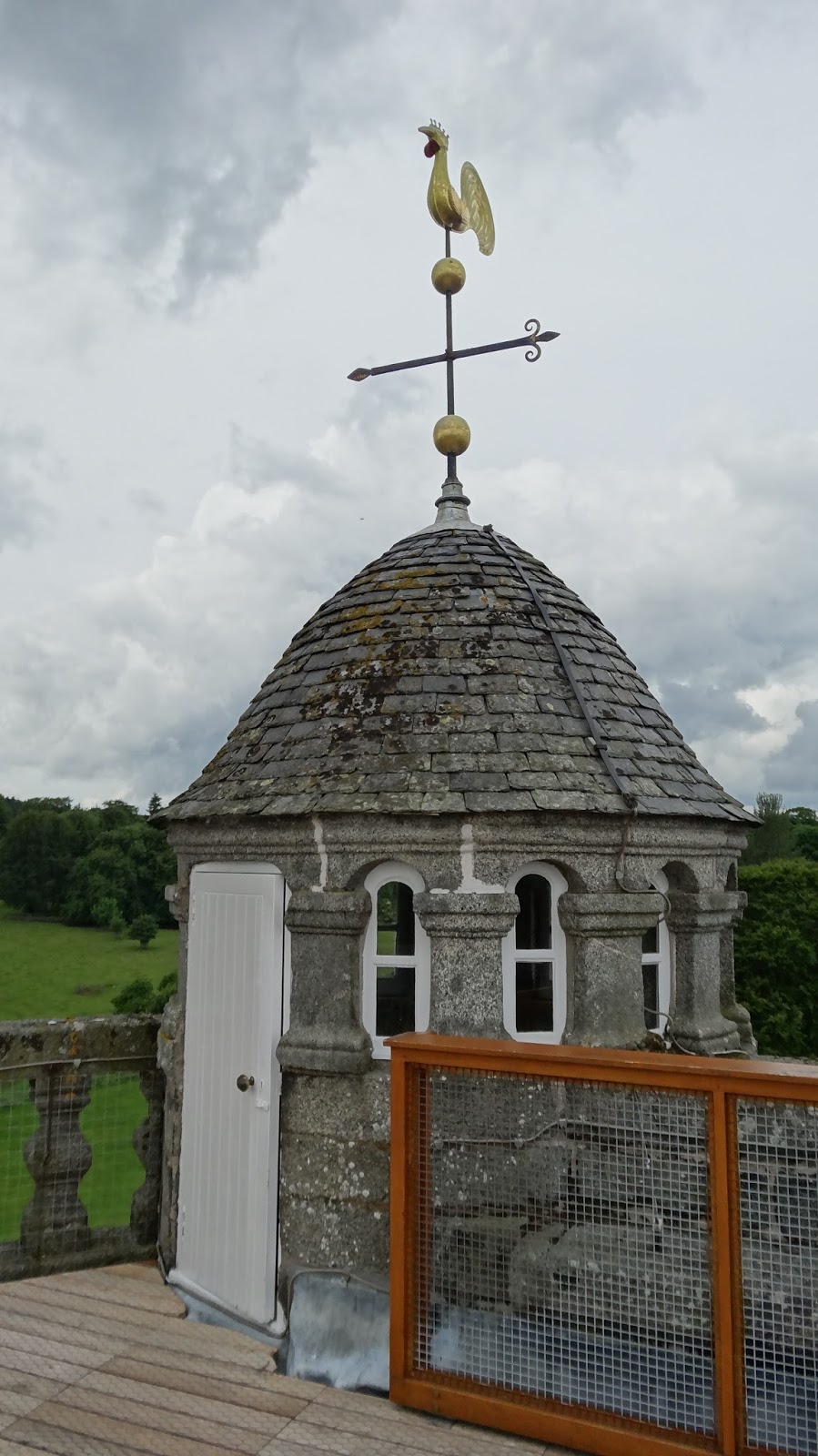
Where we came out on top of the castle.
Since the castle  belonged to the Fraser family until 1921, there are many family treasures inside.  This being the 200th anniversary of the Battle of Waterloo, several of the items on display were from family members who were at the battle.
Looking over the ramparts.
While we couldn't take pictures inside, we were allowed to climb one of the towers and out onto the roof! The higher we went the narrower the staircase.  What fun!
Down the stairs we go.

Bill looking back up at me.

We couldn't resist a picture of this enormous leaved plant.

Saturday, August 01, 2015

Searching for Pict Stones and Finding Leith Hall

We were greeted by two Bengal cats and their dog when we arrived at the Rhynie Stones carpark.
A little background on the Picts and their stones, for those who only know them from the movies, from the Pictish Stone Trail brochure we were given by Bruce the Aberdeenshire archaeologist:
"The origin of the Picts can be found in the tribal society of the Iron Age. They lived in Scotland, North of the Forth and Clyde rivers, between the 4th and 9th Centuries AD, with a particularly strong presence in what is now Aberdeenshire.  They acquired the Pict, or Picti, Meaning "Painted People" from the Romans-indeed, much of what is known of the Picts is derived from Historical writers from Outside of Scotland as they left no written records of their own."
"The Picts are renowned for their elaborate and ornate artwork, which take a variety of forms.  Best known are the large carved Symbol Stones, decorated with geometric, animal and in the later period, Christian motifs."
Class I stone from Rhynie, incised with a beast, comb and part of an arch.
The stones are classified by age and style of stone and carvings.  Class I: 6 to 8 AD. Unworked stone or boulder, incised with non-Christian symbols.  Class II: 8 to 9 AD. Usually shaped stones decorated with a cross and symbols both Pictish and Christian.  Class III:  8 to 9 AD. Shaped stones decorated with Christian motifs with no uniquely Pictish symbols; including cross-slabs, gravemarkers and free-standing crosses.


Drawing of one of the Class II stones.

What we were able to see.  Glad there was an illustration.
The village of Rhynie, where Rhynie Man was found, was a center for the Picts.  The farmers have found several stones while tilling.  Three are displayed near the old churchyard, while two are in the town center.
Brandsbutt Class I stone has been restored after being broken up by explosives.

The guide took us to several different stones, some in fields, which we hiked out to see, and one the church yard at Kintore and in a small neighborhood park.  Glad we had postal codes and a GPS.
Leith Hall
While driving to our next stone, we stumbled across Leith Hall.  It was on our list of places to visit, we just didn't realize it would be today.  Turns out they have three Pictish stones in their garden.  As it was starting to sprinkle, we decided to stop and visit the house.
Family coat of arms over an entrance.
The house is shown by guided tour, which we had just missed, so we thought we'd look at the gardens until the next one.  The rain had picked up, so we ate our lunch in the car to wait it out.  It slowed down enough for us to start out for the gardens, but then it came back again, eventually turning into a downpour.  We made a run for the house!
Bill took this picture while we were standing under trees to stay dry during a rain storm.  After the rain switched to a downpour, we ran to the Hall.
The guided tour was informative and fun!  Our guide was an older woman, with a delightful Scottish lilt in her voice.  Some of it was a bit hard to understand, but we did figure it out.  There was a family from Austria on the tour, too.  We translated for them, too; cutlery is knives, forks and spoons.


The house had been owned by the same family since being built in 1650, but in 1939 both the father and son died, one of natural causes, the other in motorcycle wreck while in the army.  Their wife and mother kept the estate going through the war, and in 1945 gave it to the NTS with the stipulation she could remain living in the house until her death in 1965.  During her last 20 years, she wrote the history of the family and helped catalogue all the possessions, so now it provides a glimpse into the middle-ranking gentry and insights into the Leith-Hay family.  We were very pleased to have stopped, plus the rain had let up so we could continue our hunt for Pictish stones.

The Moon Gate in the garden at Leith Hall.

Blackness Castle and Linlithgow Palace

Two castle built during the same period, but for completely different uses.  Blackness Castle was a military fort on the Forth of Firth, whi...