Friday, July 05, 2013

Chinon, Just for the History


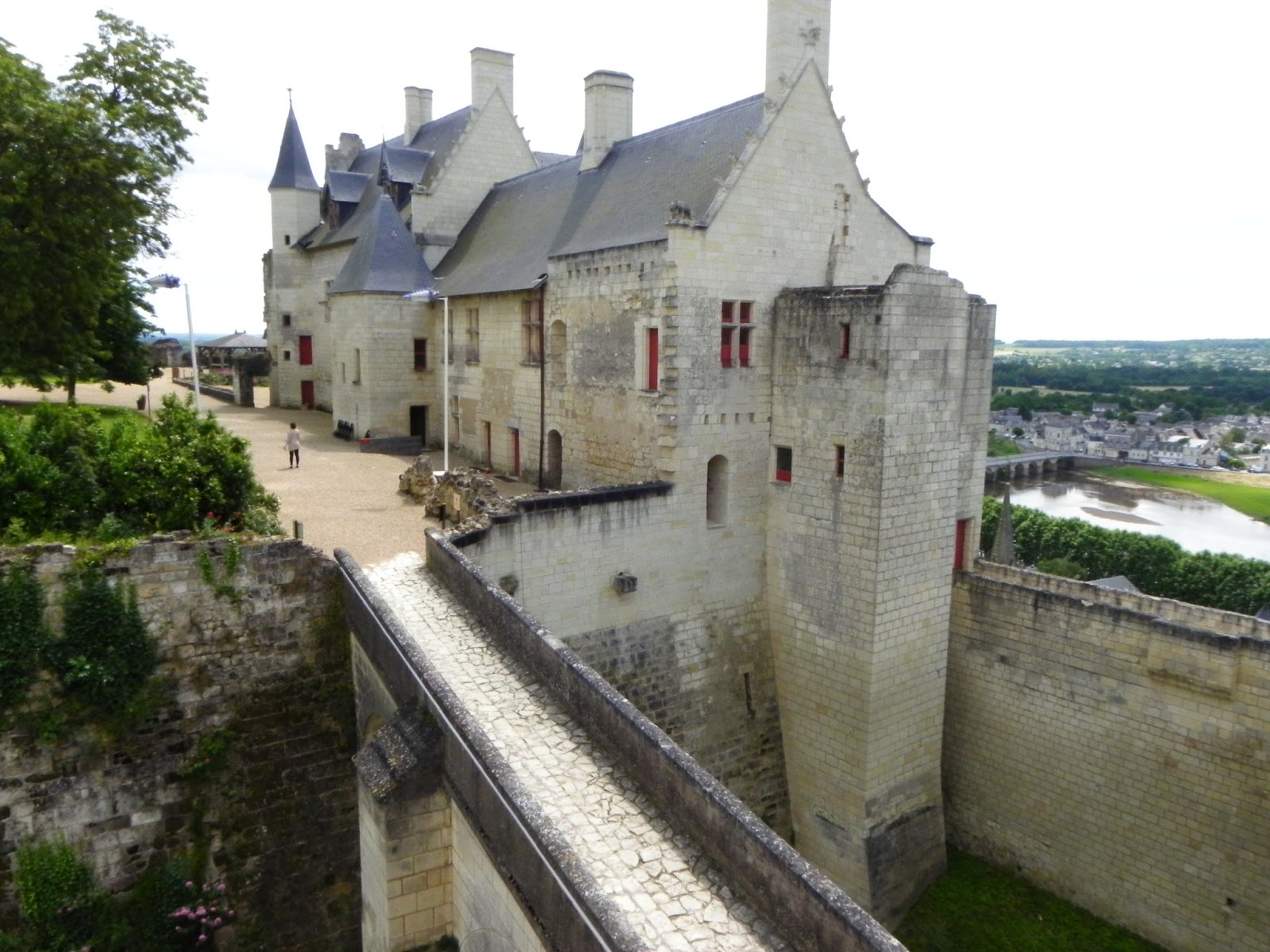
The Chateau on the hill.
The town of Chinon below.

While I was taking pictures of the dragons, Bill focused on the fortress, chateau and it's history.  In the past ten years, the French government has spent a lot of euros on archaeological digs, cleaning and restorations at Chinon.  They also built a large visitors center and gift shop, while a ramp replaced the tortuous stairs coming up the hill from the town.
The walls are tall and the moat is deep.


Henry II Plantagenet had these building added.


There is a moat running though the middle as well.

Chinon has been a fortress since the Roman's lived here.  Every succeeding group added on, until it is the  large complex you see today.  There is one room devoted to interactive screens showing how the building expanded.  The French have really gone into computer animation and touch screens big time.

There are feature both decorative.......

and functional.

The chateau is famous for being the place where Henry II, Duke of Anjou and King of England, father of Richard the Lionheart and John Lackland, died.  It was here that Joan of Arc met Charles VII in 1429. She convinced him to be crowned King in Reims.  His coronation became a turning point in the Hundred Years War.  In the 17th century, Cardinal Richelieu became the owner and proceeded to build his own chateau in Richelieu using the stones and slate he scavenged from Chinon.
The large fireplace is where Joan and Charles met.  The floor is now missing, so it is very high in the air.  The square holes are where the original floor was installed.

A plaque commemorating the 500th anniversary Joan of Arc meeting with  Charles VII.

Wednesday, July 03, 2013

There Be Dragons in Chinon!

The last time we visited Chinon, it was a simple town with a beautiful castle built on the hill above the river.  But now!  The place has been invaded by dragons!
Peaking around the corner of the clock tower, this guy was peaking back.


Two heads are better than one.  One can be awake while the other sleeps, but the snoring was really loud.

Two on the ground and one of top of  the tower.

Three heads, all of them red! 

With dragons guarding the Castle, one would not need the canon.

There are new dragons hatching.
Each dragon has their own story of how they came to Chinon.  Most are from France or eastern Europe, but one came from England, via the Harry Potter and the Chamber of Secrets.  If you see Hagrid, tell him Norbert is doing well.

When Norbert left Hagrid's care, he came to Chinon to learn to fly.
There has to be a chef in every group.

Close up of the chef.
The younger children seemed to be enjoying all the dragons; most of the adults, too.  We wondered if the management was catering to children to get more of the locals to come take a look, as it is a temporary exhibit, just for the summer.  Bill and I laughed that our children, although older at the time, enjoyed coming to Chinon for the history of the place.  They didn't need the added stimulus of dragons.

The Jabberwocky resides in this tower.  You can occasionally see  steam coming out the top.


Tuesday, July 02, 2013

The Peacocks of Chateau du Rivau

A Peacock of Chatuau du Rivau
The Gardens at Chateau du Rivau have a flock of peacocks.  They wander the grounds, greeting the visitors.  On occasion, they will stop and let you admire them, before continuing on their stroll.   There are a couple of them, who hearing a group of people talking, would head over to see what is going on.  They are curious and unafraid.

Coming closer to look in the mirror.

Can you see the beautiful creature in the mirror?
One piece of art in the garden is the Peacock Mirror.   Including the frame, the mirror is about 4' by 6', reflecting on both sides.  The peacocks love it.   There were 5 walking around it on the day of our visit.

Their tails are spectacular!
"I'm ready for my close up."


Chateau du Rivau

Chateau du Rivau as seen from the gardens.

There are many privately owned chateaux in the Loire.  The upkeep must be astronomical in both money and time.  Chateau du Rivau is one such place.  The chateau and gardens have been refurbished.  To pay the bills, they do several things.  A delightful cafe is opened for lunch, serving good food at reasonable prices.  The place was full the day we were there.  They make their own apperitif spirits to add to wines, Rose du Rivau.   They still breed horses, one of the ways they have always made money, since the original owners were breeders of war horses for the Kings of France.  There are, of course, the paying visitors, who come for the day, like us, or for a fete which happens several times during the year.  One can also have their wedding in the gardens.

Among the many trophy heads is Rudolph!

Whimsical art interspersed with trophies from the hunt.

The owners, who have a long and respectable history, while showing family heirlooms, also display their collection of modern art by artists from around the world.  Several of the artists stayed at the chateau while producing their works.  It ranges from small pieces, to enormous garden sculptures.  This place leaves you with a smile on your face, that will return every time you remember your visit.

Dragons abound in France.
 The gardens have art that is both small, as with the gnomes village or large, like a pair of boots or garden watering can.  The  woods cover the entire back of the property,  but we did not get pictures as a rain storm was blowing in.
One of the garden inhabitants.
These are the wellies one needs when it really rains.

Sunday, June 30, 2013

Agnes Sorel


Considered to be the most beautiful woman in France, Agnes Sorel was the favorite mistress of King Charles VII.  She was very powerful during her 10 years at court, but died of a strange stomach malady at the age of 25.  In 2005, testing on her skeleton revealed she died of mercury poisoning.  It's hard to know if it was intentional poisoning by a jealous court member or from wearing too much makeup, which had a great deal of mercury in it.  The researchers also used current techniques to reconstruct her face.  It looks very much like all the paintings of her.  Agnes was painted in the fashion of the time, with one breast bare.

Angels guarding Agnes Sorel.

The lighting on the tomb is beautifully done.

After years of her tomb being kept in her namesake tower in the chateau, Agnes Sorel now rests in the collegiate church of Saint-Ours, as she had wished.

Saturday, June 29, 2013

Loches, a Royal City

Courtyard of the Chateau de Loches

Loches is the nearest Big town to where we live.  We have visited here before, so knew where we wished to go; the Keep, built in the 11th century and the Royal Quarters from the French Renaissance.  We were able to park at the base of the ramparts and walk up the cobble street to an entrance gate in the walls.  There has been a lot of cleaning and restoration since we were in 2000 with Amy and John.


One of the chateau's more famous occupants was Agnes Sorel, considered by many to be the most beautiful woman in France during her life.  It also helped that she was the king's favorite mistress.

The Donjon, built in the 11th century, is considered the best preserved Keep in Europe. 

The two young women working at the front desk were very helpful.  We asked about a pass which would get us into several places; while they didn't have that, what they did have was a pass that would give us a year of admission to Loches chateau, as well as discounted admission to 7 other places.  All for only 4 euro more than the normal price.

Walls are an important part of any fortress.

When we looked over the wall from the top of the Donjon, we saw our car, way down below.

Canons were mounted on top of the Donjon.

To get to the top, we climbed many, many stairs.  Several were worn down in the middle from centuries of use.  Watch your step!

Thursday, June 27, 2013

Garden Wall or Roman Aquaduct?

The good thing about using a GPS is it gets you close to where you wish to be when finding old things that are out in the middle of nowhere.  The bad thing about a GPS is it sometimes only gets you close, so you have to find a higher, clear spot to look for where you want to be.  So it was with the Roman Aquaduct near Luynes.  Fortunately, aquaducts are tall things, so they show up in the middle of crop fields.

Built about 200, there are 14 arches still standing.

A bit of height comparison, I'm 5'7".

The landowners sited their house so the aquaduct could be used as the garden wall.    On the other end of the house, the aquaduct is one side of the barn yard.

The aquaduct is now a protected ancient monument.  The locals have built a parking area, complete with sign and garden bench just across the road.  Bill sent a message to Garmin with the correct coordinates, so their newer maps will get you to the right place.

Wednesday, June 26, 2013

Richelieu


In 1632, with permission from Louis XIII, Cardinal Richelieu (you may remember him from the "Three Musketeers", but he was a real and powerful person) built the original "Gated Village" for the rich and famous.  He also built himself a magnificent chateau, just outside the town, which did not survive the Revolution. Even after 200 years, he wasn't well thought of.

The gate house to Richelieu's gardens; the chateau is gone, but the gardens remain.
Being a modest man, he named the town after himself, Richelieu.  It is a walled rectangle with 4 gates.  At each end is a large square plaza;  shops and other public places on one, and the church anchoring the other.  Along the Grand Rue that connects the squares are 14 identical houses on each side.  Richelieu gave the land and built the houses for the rich and famous.  Each has a substantial gate large enough to drive a carriage into a courtyard with the house built around it, 3 stories tall.  Since the houses were identical, I assume the competition was to decorate them better than your neighbors.

One of the four gates into the village.
Plain or fancy?

The Market Hall, an essential part of village life, although I don't think they use this for their market days.


Rue Grande with the matching 14 houses on either side.
We enjoyed walking around Richelieu.  The gardens were closed, we think because of a violent storm that hit the area on June 17th.  It was easy to imagine how the houses on Rue Grande looked when they were new; shiny black slate roofs, beautifully painted stucco with the clean white of the limestone block trim for contrast.  The Market Hall has been refurbished with glass installed around the outside to make it more usable in all weather, as well as secure it for paid events.

Monday, June 24, 2013

Le Grand-Pressigny

Old part of the chateau and the donjon viewed from across the courtyard.

Le Grand-Pressigny is just a few kilometres from where we live.  We drove over in the rain, since it has rained a little every day we have been here.  In Le Grand-Pressigny we went to the Musee Prehistore which has recently opened a new wing and cave built on the grounds and attached of the Chateau Le Grand-Pressigny.  The original chateau is mainly a ruin, one of the towers fell down in 2009.  Wonder if this was the impetus to renovate, restore and eventually build a new museum?  The newer wing, built in the renaissance era, now has the new musee attached.  The grounds are well done, the view is spectacular, or at least it would have been if the sun had been out instead of clouds.  Instead, it has an impressionist feel.
Le Grand-Pressigny viewed from the chateau.

The old and the new meld together at Chateau  Le Grand-Pressigny.

The musee is not very large, but is very well done.  The displays are well signed, plus they have an audio guide in English.  The caves were recently restored and reopened.  They still feel ancient, but the displays are very modern.      www.prehistoiregrandpressigny.fr
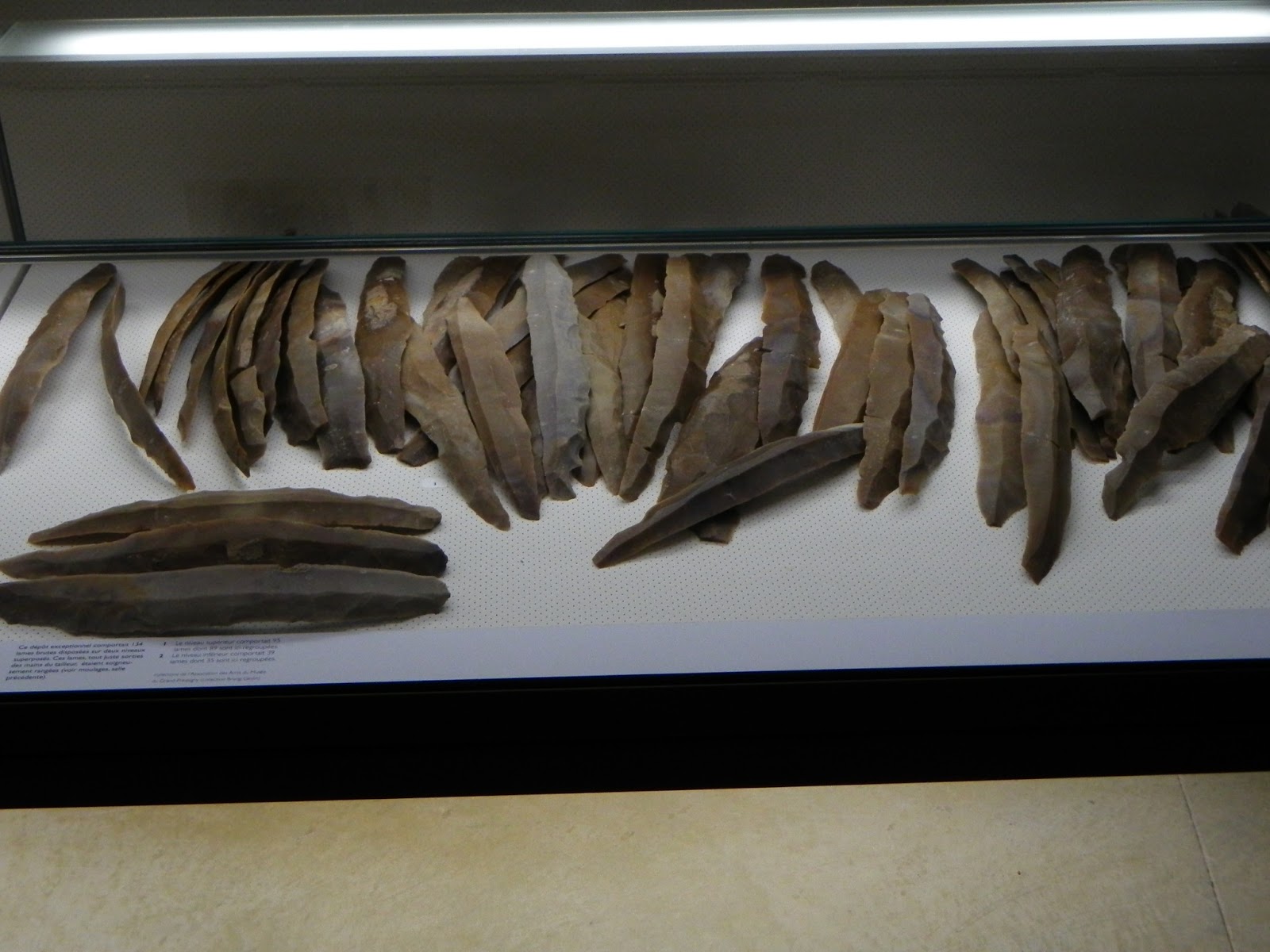
Flint knife blades from one of the prehistoric cache sites around the area.

Flint core; to make the knives, they slough off ribs from the outside, the inside being too soft to use.

This area is famous for it's flint.  People have been mining it since the neolithic time to make points and knives.  Since we have found this out, we've started looking for flint used in buildings and walls.  We even found some in the rock used for paths at another chateau.

Saturday, June 22, 2013

A Tale of Two Cars

To get from Orly Airport in Paris to Ferriere Larcon, we rented a Peugeot 208.  A two day rental was only  $8 more than the one day, which would also give us the extra day to deal with our jetlag.   So, on Sunday morning we got up and drove to Descartes to the market.  (Silly us didn't take any pictures, blame it on the jetlag!)  The house car, a Citreon, stayed parked.


Peugeot 209


Monday, we did the morning chores and dog walking, ate a light lunch and cleaned up to return the car to Tours, planning to do a bit of grocery shopping on the way home.  Bill was to drive the rental, me the house car, but the house car wouldn't start!  The ominous sound of a dead battery was coming from under the hood.  We looked around for cables to jump it, but no luck.  What to do?  Bill found an illustrated French dictionary with the words we needed.  We tried calling the numbers left for friends who might help; one wasn't home, the other only spoke French and didn't understand mine, even though I did use my very best pronunciations. (Which were probably incorrect!)
Both cars in front of the house before we realized the battery was dead on the Citroen.

Bill took the dictionary and walked down the street to a neighbor, Jo Jo, we had met while walking the dogs the first evening.  When he arrived at her house, the top of the door was opened, so he knocked.  The couple were eating their lunch, the man looked up, we had not met him.  He said something in French, then his wife waved her arms, looking very angry and told Bill to go away!  Every time he tried to say something, she would repeat,  Go AWAY!  Bill stepped back from the door, then stood there thinking what to do next. She realized he was still there and came over to the door.  Before she could say anything, Bill said, in French, I am living in Pauline and David's house.  Jo Jo was immediately apologetic, saying she saw the book and thought Bill was a missionary!  Her husband, NauNau brought his cables and we jumped the car.   Merci!

The drive to the airport in Tours went smoothly, but I never turned the car off!  We drove back to Ligeuil to the smaller grocery store, Simply, instead of trying to find the big Le Clerc in Tours.  Bill sat in the running car while I did the shopping.  As he was waiting, a couple came up to the car saying in French, This is David's car!  Turned out they were the French speaking friends we had talked to earlier.  Between Bill's French and both of their use of charades, a fun conversation was had!  They were gone by the time I finished shopping.   We arrived home, finally turning off the engine.  Later in the evening, Nau Nau came with his battery charger to run over night.  It worked like a charm!   Merci pour votre assistance, Jo Jo and Nau Nau!

Blackness Castle and Linlithgow Palace

Two castle built during the same period, but for completely different uses.  Blackness Castle was a military fort on the Forth of Firth, whi...