Monday, October 14, 2013

Tour Philippe le Bon

View down the stairs.

We first saw the ad for climbing the tower of Philip the Good in our gite, along with lots of other information on things to do and see in Dijon.  Now, we always enjoy looking at the world from on high, and the only warnings were for pregnant women or people with limited mobility, since it has 316 steps up.  We don't fall into either of those categories, so.....

The first place we stopped had this beautiful vaulted ceiling.


View out the stained glass window.

Looking down on the Place de la Liberation.

View across the town.

Cathedral St Benigne shows really well.

Cathedral St Michel, which is hard to see close up.
The tower is part of the Dukes of Burgundy's palace.  It was never a fortification, but a residence.  The stairs were the ones used by the owners to get to their apartments in the palace.  So, they are easy to walk up and down, not those tortuous , uneven, medieval stairs we have so often climbed.  Our tour guide was a young woman who spoke both French and English.  She would talk to all the others, then give us the tour.

Another, more subtle, decorated tile roof.

While this looks like part of a roof, it is actually the original wall of the castrum built by the Romans.  Philip used it as the base for his tower.  Recycling strikes again.
There were two young women on the tour who were Americans.  They were living in Dijon and working as teaching assistants in the school, helping the students to learn English.  Of course, they were both fluent in French.  One was from Virginia, while the other was from Missouri, but went to school at SMU in Texas.  It is a small world after all.
After all those stairs, a refreshing Kir to celebrate.

Friday, October 11, 2013

Jacquemart


The clock on top of Notre Dame in Dijon is known as Jacquemart.  The duke, Philip de Hardi, took the clock as war loot in 1382 from Courtrai, now Belgium.  He gave it to the people of Dijon in 1383, as a thank you for their help in the Flanders war.  In the 17th century, people joked about poor Jacquemart's bachelor status, so in 1651, a companion was added for him: Jacqueline.  In 1714, people made fun of their infertility, so a little Jacquelinet was made for them, who was joined in 1884 by Jacquelinette, to mark every quarter of an hour with him.  Thanks to The Owl's Trail from the Office of Tourism for this information.


Cathedral St Benigne

The present gothic church which replaced the one that collapsed in 1280..
St Benigne's cathedral is dedicated to the first local martyr whose 2nd century sarcophagus' base is in the crpyt.  I'm not sure what St Benigne did to become a saint, but his death was apparently spectacular.  Who ever it was that killed him, put two lances through him from side to side, bottom to top.  Then they put an iron bar down into the top of his skull.  They also took his fingers and stretched them out until they resemble ET's, from the movie.

Saint Benigne looks amazingly calm considering all that has been done to him.  Maybe that is why he is a saint.

The decorated tile roof, a Dijon specialty.  

Carving over the entry doorway.
The church building has been cleaned over the past few years, with only one small section left to be finished.  They were working on it the day we visited, so the air inside the church was filled with fine dust particles.  Someone is going to have a big job dusting everything when they are finished on the outside.
Looking toward the nave.
This side alter is done in the same colors as St Chapelle in Paris.  Two of the windows are stained glass, but the two which have inside walls have the stained glass painted on the wall, instead of being glass.

The organ comes with an angel on top of each wood carving.  They are playing an array of instruments to liven up the music.  

This building was badly damaged during the revolution with the rotunda partially collapsed.  The underground level was preserved, but only because it was  filled in.  In 1860, excavations were started to return it into use.  There is still work to be done, but who knows when or if it will happen.
The stairs down into the crypt.  

The large stone is all that remains of the sarcophagus of Saint Benigne.
When the mortuary chapel was originally built in Gallo-Roman times, it was at street level.  Over the centuries, like everything else, it was swallowed by the refuse of the city and is now totally buried.

Looking toward the mortuary chapel.

The undergound storey of the romanesque rotunda.

Light coming into the rotunda from above. The rotunda was built in 1002-1005.  

Going in to the crypt costs 2 euro each.  We were glad we paid to see it.  This is probably the best preserved crypt we've seen besides the one in St Denis in Paris.  The acoustics were excellent, as I did my usual singing to check them out.


Vendors on the Outside of Les Halles

Beautiful pots of blooming plants.

Bouquets ready for your home.
On the outside of Les Halles are vendors who are ready to sell you most anything you can think of, including some food products.   The rows of flower stalls are beautiful.  There are blooming plants, cut flowers and even silk flowers that look very real.

A different type of mushroom than the little white ones in the styrofoam boxes at Safeway.

Another type of mushroom.
This is the season for mushrooms.  The displays are piled high, some are reasonably priced, while others are, to our untrained pallet, outrageous.  The locals look at them, smell them, and finally make their selections.

Peppers by the bag full.

Display of root vegetables, with the black radishes front and center.
When you have had your fill of foods, it's time for other shopping.  The market has clothing to dress you from the skin out.  There are sellers of sewing goods, upholstery, furniture refinisher and rebuilders, leather goods, shoes, and on and on.
Bought too much?  Time for a new shopping basket.

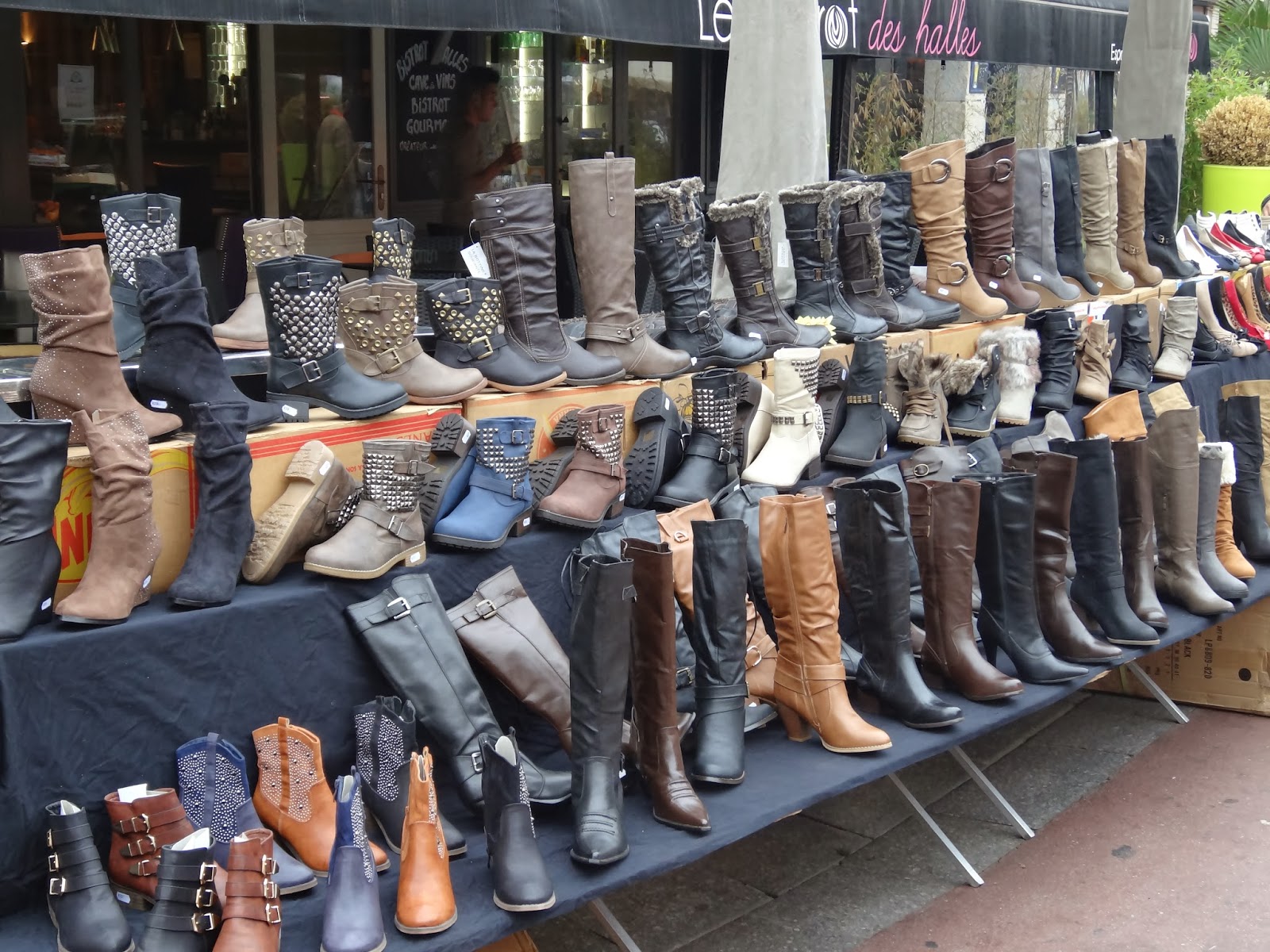
Boots to keep you warm and dry during the wet winter; or to be tres chic.
We always want to buy, but the reality of getting it into our suitcases to go home, prevent us.  Oh, and maybe that little thing called money.  It doesn't matter if we buy or not, going the market is still one of our favorite things to do.

No French market is complete without a linen seller.

Thursday, October 10, 2013

Food in Les Halles

Fish

The market is full of food.  There are the produce sellers, who have some very interesting vegies such as black radishes.  The heads of lettuce are huge and the selections are so much more than the iceberg we get in the US.  You want some fish?  There is fresh or salted, either from the lakes and rivers or the ocean.  The butcher has every sort of meat, some with body parts still attached so you can be sure of what you are buying.
Baked goods.
If you don't want to cook, there are baked goods.  Quiches, savory or sweet tarts, pates, pizzas, cakes, cookies, and breads with delicious toppings.  We bought a Provencal tart made with tomatoes and zucchini which we warmed up for lunch.  YUM!
Vino
One seller had a wide selection of wines from other places besides Burgundy.  Then there are the folks who specialize in the local wines and liqueurs.  So many choices, so little time to try them out.
Ham

Lemons
We can not forget about the cheese.  I think we have tried several hundreds of types of cheeses since
we have been traveling to France.  Each part of the country has their own specialites.  The green one in the picture was new to us, but we didn't buy any, as we had several in the gite waiting to be eaten. 
Cheese

Tuesday, October 08, 2013

Les Halles de Dijon

The main entrance of Les Halles.
The market in Dijon is held in Les Halles, a beautiful building designed by Gustav Eiffel, who was born in Dijon.  It is a steel framed building with beautiful glass to let in the light.  The feel is more glasshouse than institutional.  An entire city block is covered by the building.  There are vendors all along the outside, as well as expanding down the side streets.
Our first view of Les Halles.  Retractable awnings protect the outside vendors.
On the outside of the building, vendors are covered by retractable awnings.  Here you will find everything imaginable for sale; food, clothing, antiques, flowers.  We visited on Tuesday, which is their slow day.  We are planning to go again on Friday.  It's suppose to rain, so there may not be as many outside vendors, but the inside should be full.

Although crowded with vendors and shoppers, the place is expansive.  The locals were out in force to fill their shopping carts.
Vendors have booths they rent.  
The Market inside is mainly food; fresh produce, fresh meats, cheeses, wines, and of course, since this is Dijon, mustards.  Dijon is also famous as the birth place of the Kir, a drink made with white wine and creme de cassis.  Our favorite is Kir Royale, made with champange and creme de cassis.
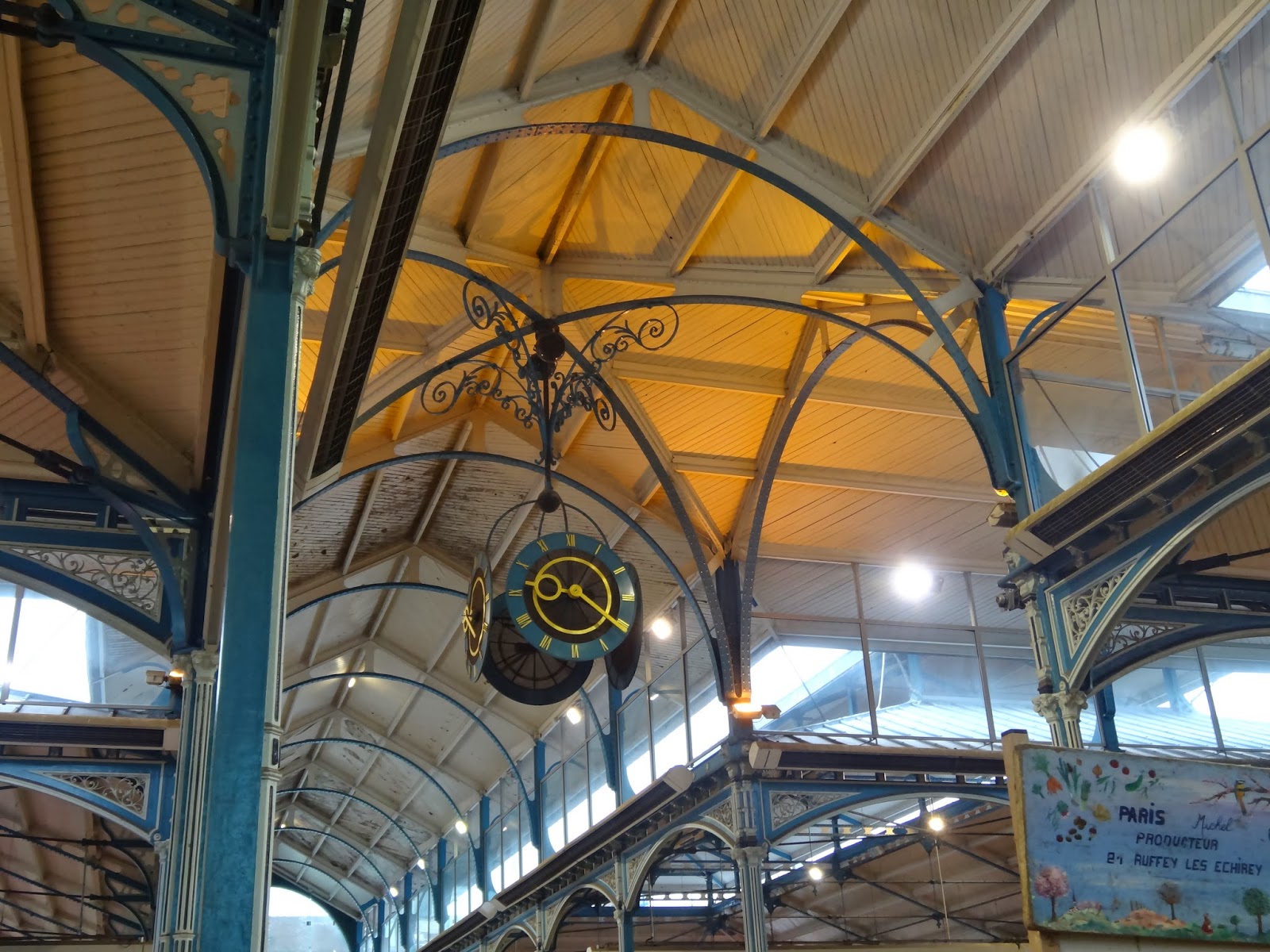
The clock is positioned high in the middle for all to see.
We spent most of our first walk though staring up at the ceiling and windows.  Although built in 1868,  the building has been wonderfully maintained; a true treasure for the Dijonnaise.
A more modern addition, the tile floors are easy to keep clean. 

Monday, October 07, 2013

Jardin Botanique a Nice


The gardens are laid out according to where the plants originally grew.
We tried to go to the botanical gardens the last time we were in Nice, but we couldn't find the bus stop.  It wasn't because we didn't try; we must have walked 5 miles that day, with no luck.  So this time, we went to the offices for the bus, found the route map we needed, and set off.  It still took us a bit, but we knew which direction to head and soon were waiting at the stop with the correct bus number.
Sago Palm; we have these in our yard in Tucson.
The gardens are divided into sections, by country or area the plants are from.  Since this is a mediterrean climate, the plants are too.  Some are doing better than others, though.  The cactus look to be getting too much rain.
Agave Americana; a native to the American Southwest.

Nolina Interrata Gentry
 There are several plants we recognised from home and several we took note of to add to our landscape, if we can find them, such as the Nolina Longiforia.
Nolina Longiforia; loved the bark on this plant.  

Agave Attencata

Crassula Pubescens

Cook Island Pine
 The gardens are built on the side of the hill.  There are several great views off towards the sea.  The day we were there, the haze was too bad to take good pictures.
One of the locals, just hanging out in the sun.

No botanical garden would be complete without a water feature.

No water feature would be complete with a gold fish.
 While waiting for the bus to take us to the gardens, we noticed a rubber tree across the street.  Truly a tree.  I know they get snow here on occasion, but I guess it didn't hurt this guy!  We both started singing,"Whoops there goes another rubber tree plant!"
A really, really tall rubber tree across the street from the bus stop.  It would take a big ant to move this one!

Blackness Castle and Linlithgow Palace

Two castle built during the same period, but for completely different uses.  Blackness Castle was a military fort on the Forth of Firth, whi...